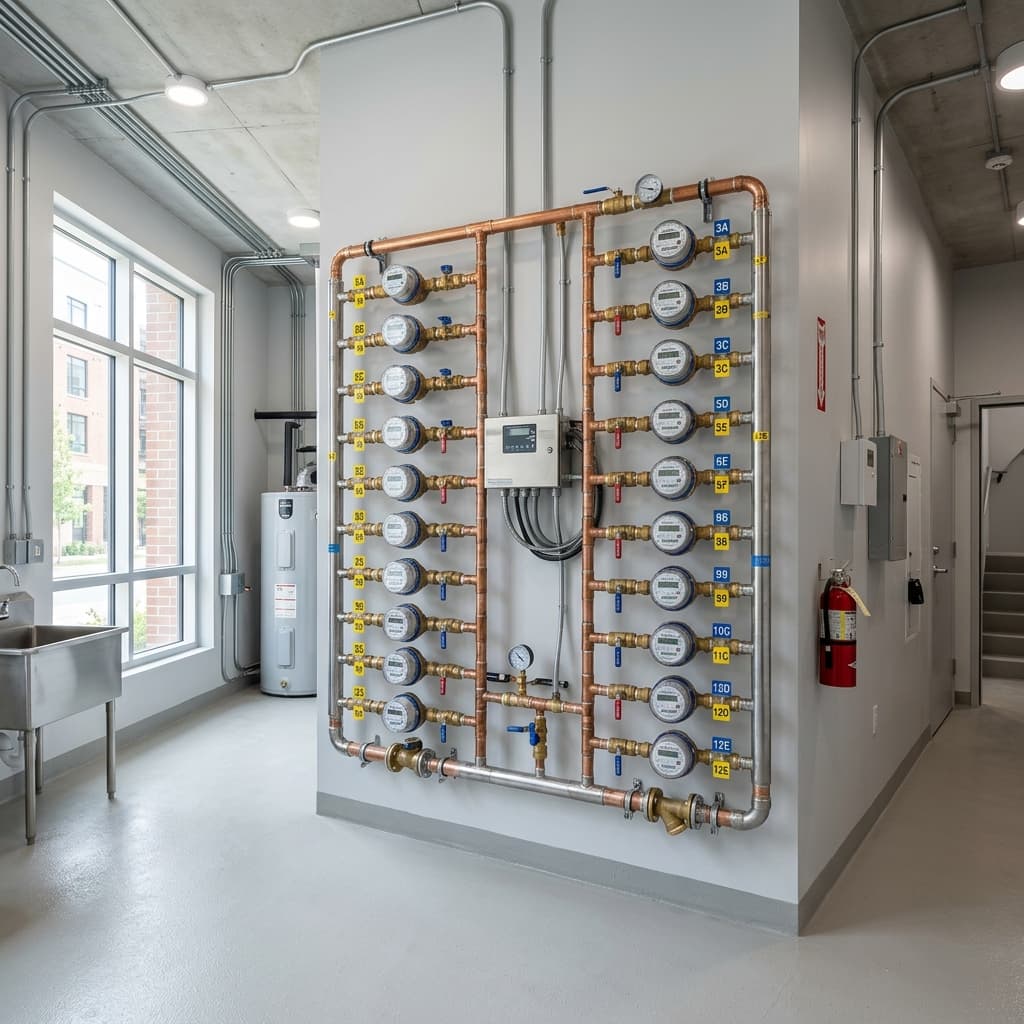
Fair Water Allocation for Condos & Strata
Eliminate flat-rate water billing in multi-family buildings. Ultrasonic cellular submeters deliver direct suite-level readings without building WiFi or comms wiring.
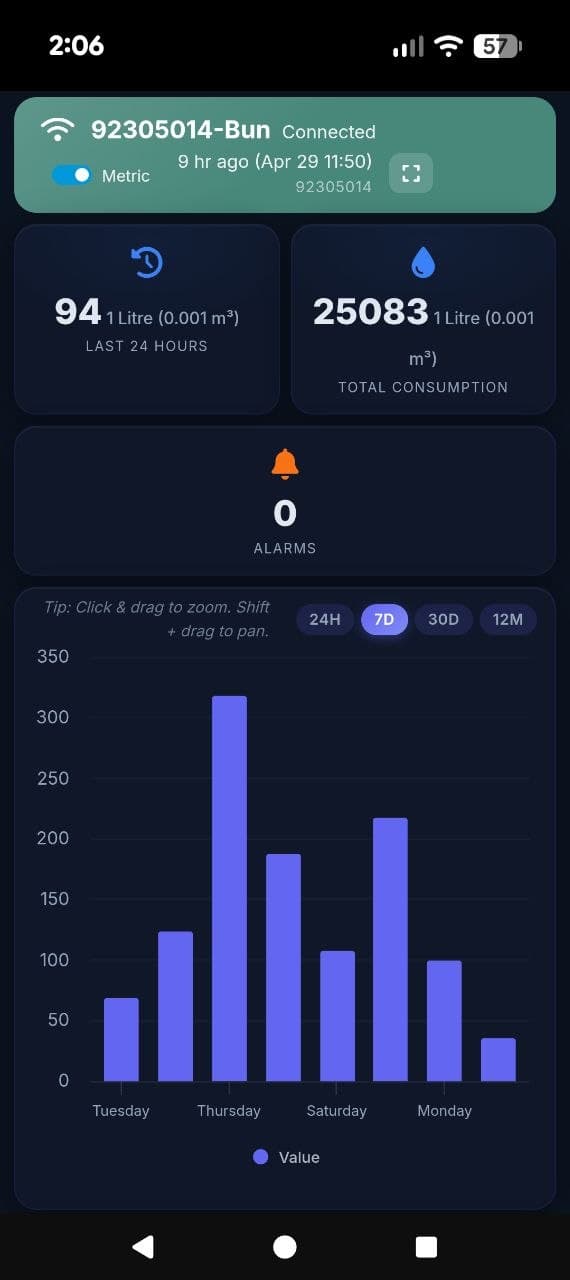
Zero site IT, zero customer WiFi needed. Readings transmit over cellular straight to your phone & tablet.
The bulk bill is the dispute
A strata with one building meter pays the total and divides it by unit entitlement. Everything that goes wrong with that is invisible on the invoice.
It works right up until one suite runs a toilet all winter, one owner short-term rents, and the owner who lives alone pays the same share as the family of five upstairs. Council has no answer because council has no data — so the argument at the AGM is about fairness in the abstract, and the only lever anyone can pull is the strata fee. The bill is not really the problem. Not being able to answer "whose" is the problem.
Toronto's Block 1 water rate, effective 1 January 2026 — a 3.75% increase for Block 1 consumers. Every suite that wastes water spends the building's money at this rate.
City of Toronto, 2026
What one continuously running toilet costs. At roughly 1 L/min (0.26 US gal/min) that is about 526 m³ (139,000 US gal) a year, priced at Toronto's 2026 Block 1 water rate — from a single suite, on a bill the whole building shares.
Arithmetic on the City of Toronto 2026 Block 1 rate
reduction in water use that the Province of British Columbia says metering can help achieve. That is the Province's figure for metering generally, not a MaxLinc promise about your building.
Province of BC, 2025
What you are not installing
Submetering projects rarely die on the meter. They die on everything the meter used to require.
No wiring, no conduit
Nothing to pull between suites, nothing to fish through a demising wall, no low-voltage home runs back to a panel room, and no electrician on the schedule.
No concrete drilling
The line item that stalls strata retrofits is coring the slab for a cable path. There is no cable path here, so there is nothing to core and no structural review to book.
No M-Bus network, no repeaters
Wired M-Bus and RF mesh both leave behind a topology somebody owns forever — segments, repeaters, addressing, a commissioning day, and a re-commissioning day after the next renovation. None of it applies.
No gateway, no building IT
Nothing joins the building network. No static IP, no firewall rule, no router password that changes when the manager does, no panel in the electrical room. Each meter carries its own managed SIM.
The install is a plumbing job on a suite supply line, done at the suite or at the riser. The only trade that has to be on site is a plumber.
Two ways to submeter a tower
The meters cost roughly the same. The difference is everything the strata has to buy, permit, own and eventually replace around them.
Wired or M-Bus retrofit
- 1Meters in every suite
- 2Cable runs or M-Bus segments
- 3Repeaters and concentrators
- 4Panel-room data collector
- 5Building network and a static IP
- 6Someone who maintains all of it
Every line below the first is a cost, a coring plan, a permit conversation and something that can fail years after the contractor has gone.
MaxLinc cellular
- 1Meter on the suite line
- 2Cellular
- 3Canadian cloud
- 4Council's browser
Nothing sits between the suite and the council's dashboard that the strata has to buy, own or maintain.
The usual BC route is a 3/4 vote, not a unanimous one
The most common reason a strata drops submetering is a council being told it needs unanimity. For the route most stratas actually want, that is not what the Act says.
Two different things get confused with each other, and they sit under two different parts of the Strata Property Act. Separating them is usually what unblocks the project.
Metering is information, not billing
Installing meters and seeing per-suite consumption does not by itself change what anyone is charged. It is an expenditure and suite-access question for council, not a fee-structure question. Many stratas stop here on purpose for the first year: measure, find the leaks, and bring owners a real number before proposing anything.
A consumption-based user fee — bylaw by 3/4 vote
Section 110 of the Strata Property Act lets a strata corporation impose user fees. Regulation 6.9(1) permits them only where the amount is reasonable and the fee is set out in a bylaw, or in a rule ratified under s.125(6). Regulation 6.9(2) then says the fee may be a fixed amount or an amount determined on a reasonable basis — expressly including "the user's rate of consumption". A bylaw amendment passes on a 3/4 vote. This is the route most stratas are looking for, and it is not unanimous.
Changing the strata-fee formula is a different section
Rewriting how strata fees themselves are calculated — moving off unit entitlement — falls under s.100 and requires a unanimous resolution of all eligible owners, including the ones who never come to a meeting. That is the hard route. A consumption-based user fee is how most stratas avoid needing it.
The question to put to your strata lawyer
Section 110 is framed around fees for the use of common property or common assets. Whether water delivered to a strata lot fits that framework, and how the fee is drafted so it is "reasonable" under Regulation 6.9(1), is precisely the question a strata lawyer should answer for your building before a bylaw goes to a vote. We can tell you what the meters measure and what the reports show. We cannot tell you what your bylaw should say.
Ontario condominiums
Ontario condos allocate common expenses according to the declaration, so a consumption-based allocation depends on what your declaration says and on what amending it requires. Metering and monitoring are available regardless of that answer — you can measure, find leaks and control cost without touching the allocation. Have the declaration reviewed before you plan any re-allocation.
Rented suites are a separate question
A strata user fee is charged to the owner. What an owner may then pass on to a renter is governed by tenancy law, not by the strata, and it is genuinely restricted: Ontario's Residential Tenancies Act s.137–138 caps apportioning at six units; in British Columbia the terms must be set out in the tenancy agreement (RTB Policy Guideline 22); Quebec is restricted; Alberta follows the lease. Do not plan a program that depends on billing tenants until you have confirmed your province.
Summary only, current to 2026, and not legal advice. Confirm the route for your building with your strata lawyer or property manager before you change how anyone is charged.
The leak nobody reports is the one in the empty suite
Water damage in a tower rarely starts as a flood. It starts as flow that never returns to zero, overnight, in a suite nobody is standing in.
Flow that never returns to zero
An ultrasonic meter with no moving parts registers the slow, continuous trickle a worn mechanical meter can miss. If a suite's flow never drops to zero across a night, that is a running fixture, a failed fill valve or a weeping connection.
An alert that week, not at the next AGM
Continuous-flow and consumption alarms go to whoever you choose — council, the property manager, the on-site caretaker — while the water is still running rather than after the drywall is off.
The vacant, listed or short-term-rented suite
The suites that cost a strata the most are the ones nobody is living in. A meter does not need anyone to be home to notice.
Two years of history when it is disputed
The meter stores 24 months of frozen historical data plus the last 36 days, and the app keeps the record. When an owner disputes a charge or an adjuster asks when it started, there are dates.
What we will not tell you
We make no claim about your premium or your deductible. The products marketed for insurance credits are automatic shut-off devices — this is a meter, and it does not close a valve. What it does is tell you the water is running. Whether that matters to your insurer is a conversation with your broker, not with us.
The productThe meter that goes on the suite line
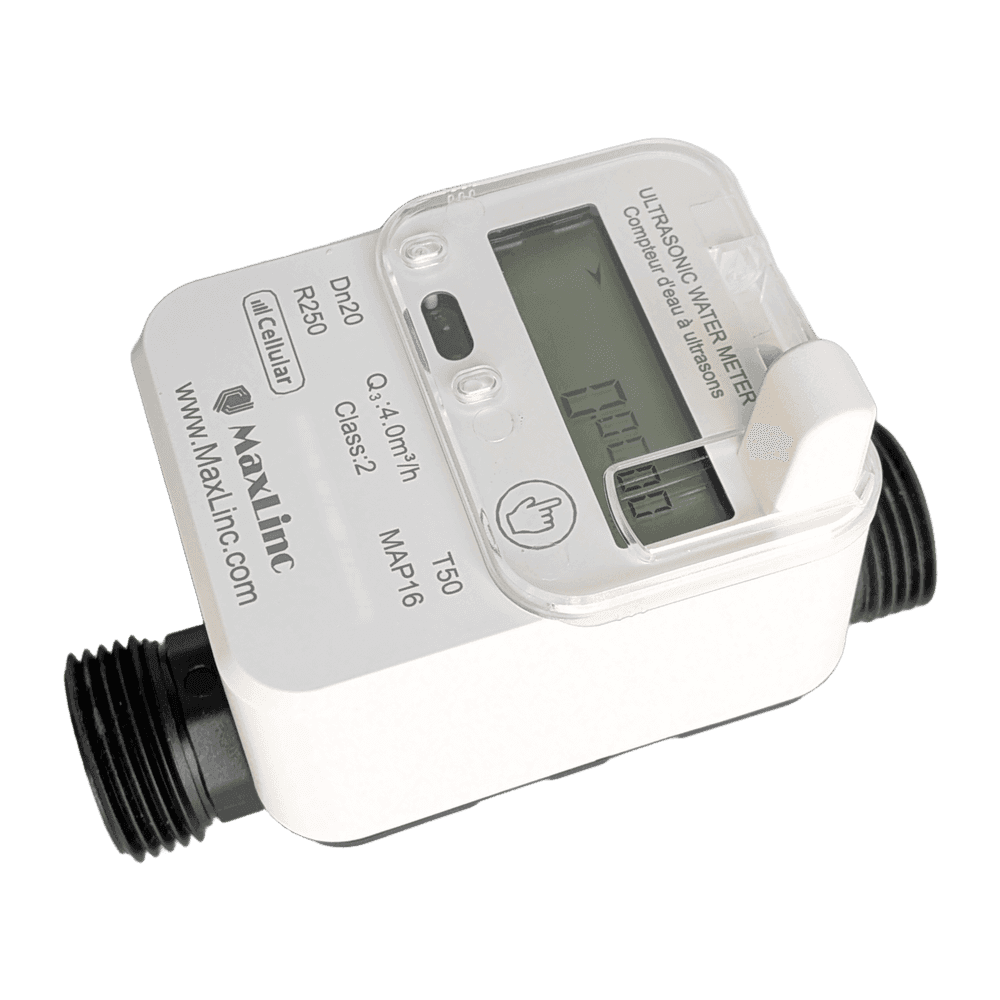
An ultrasonic transit-time meter with no moving parts, in an IP68 body, that reports over its own cellular connection with a managed SIM already inside. Sized for the 3/4" and 1" lines a suite actually has.
- No moving parts — nothing to jam, seize or clog on a suite line
- U0/D0 flow-field rating — no straight run of pipe needed before or after it
- IP68, so a wet mechanical closet or a flooded riser pit is not a problem
- Two-way metering with reverse-flow detection
- Multi-view LCD with a single touch button, so a plumber can verify on the spot
Meter product pages:
What council sees at the next meeting
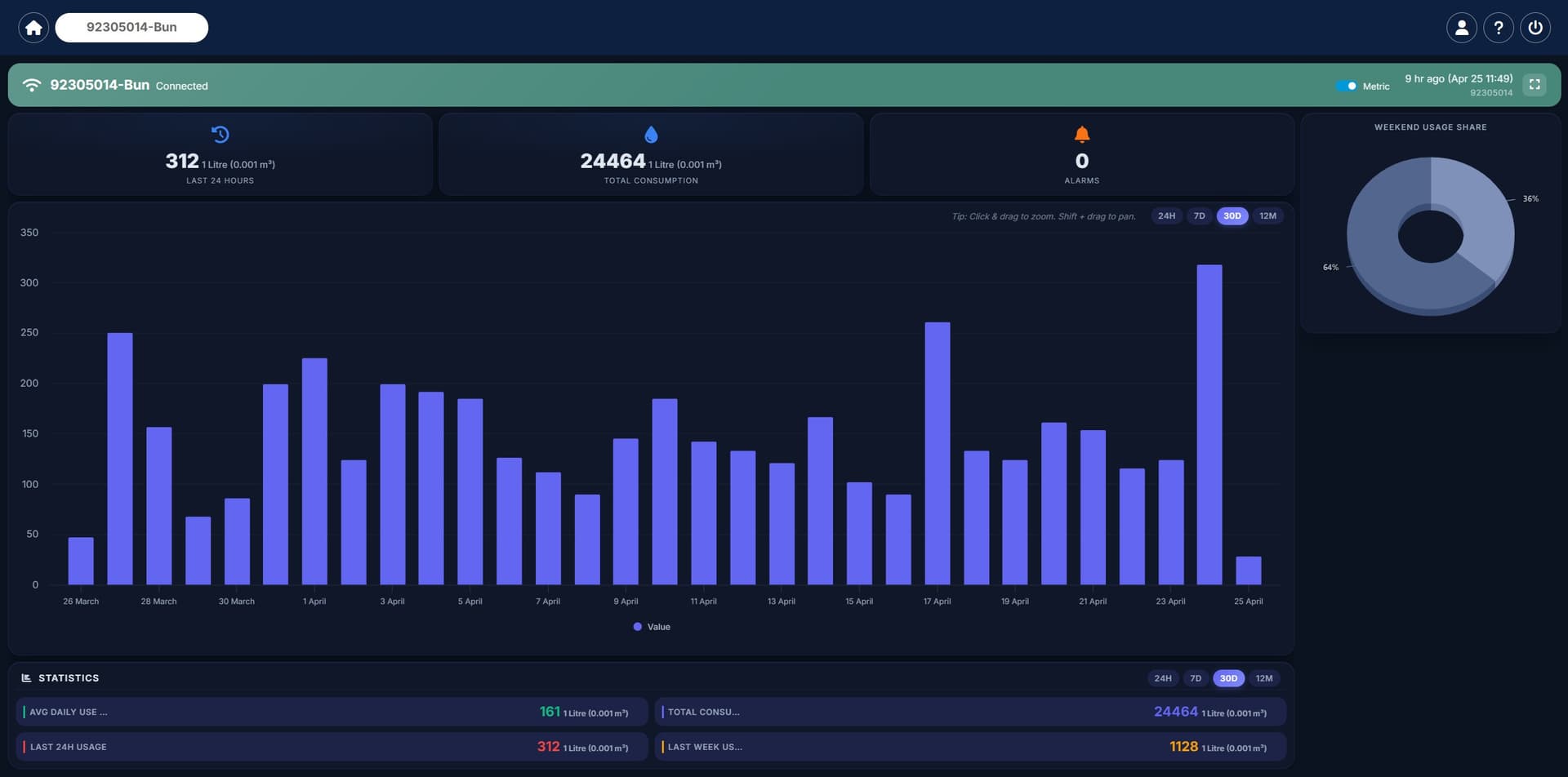
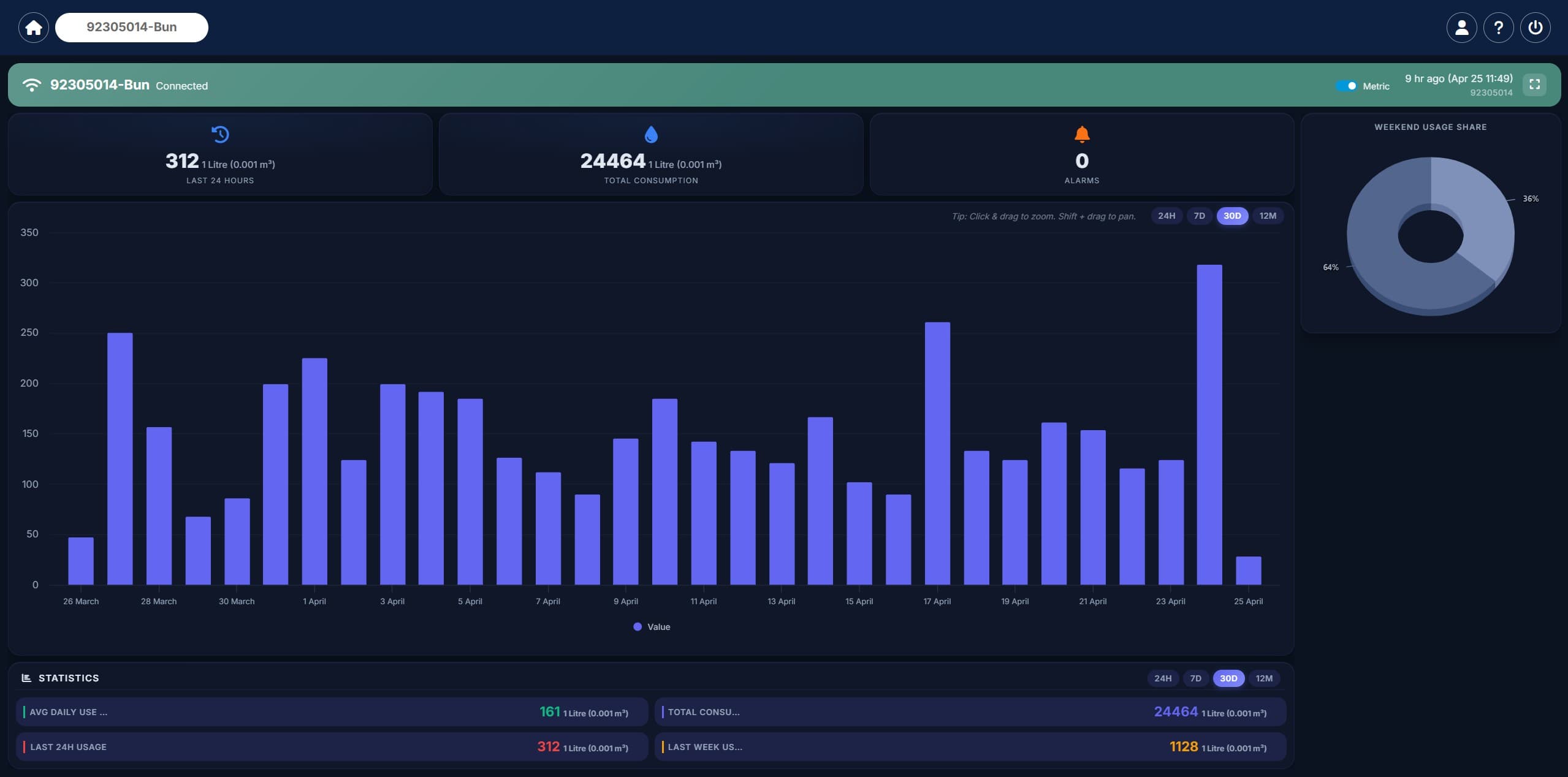
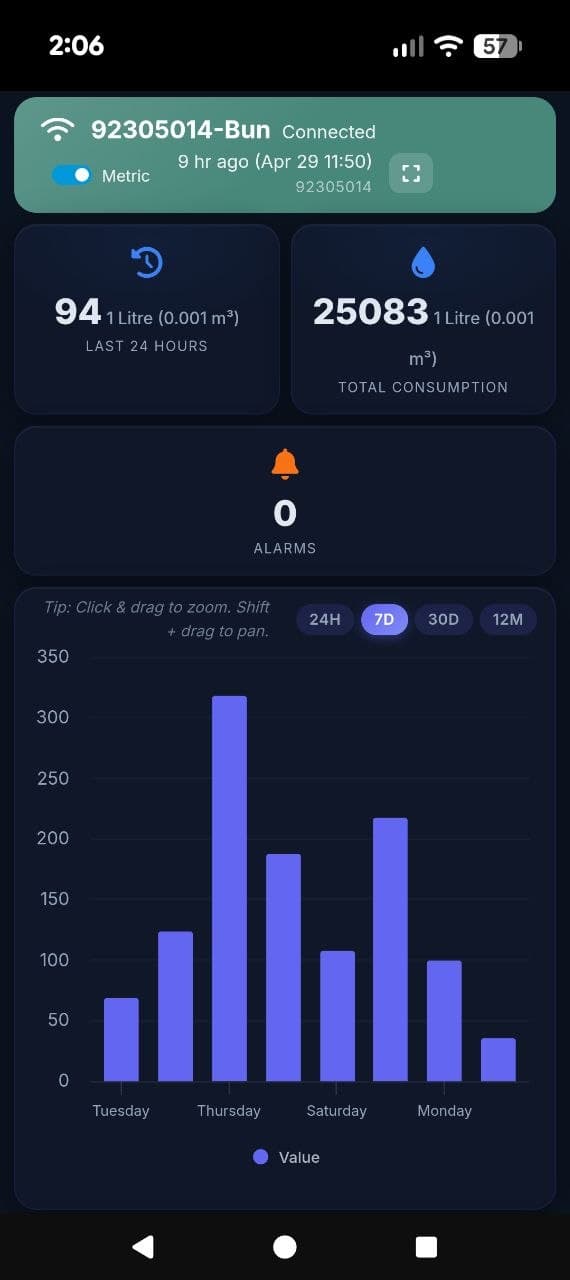
The meter is the sensor. What ends the argument is the report.
Every suite, ranked
Sort all suites by consumption over any period and see the top ten in seconds. This is the slide that turns an AGM argument into a decision.
Reconcile against the bulk meter
Do the suite totals add up to what the city billed the building? See the gap, and whether it is sitting in common areas, irrigation or one suite.
Continuous-flow alerts
Flow that never stops raises an alarm to whoever you choose, per suite or across a group of suites.
Custom consumption alarms
Weekly, monthly or rolling-window limits. Unlimited rules, set per suite or building-wide.
Reports the manager can work from
Daily, weekly, monthly and annual reports, exported to Excel for the property manager's accounting system.
No-upload and device alerts
If a suite meter goes quiet you find out that week — not while you are assembling the year-end.
Consumption data is stored in Canada.
Installing in an occupied tower
Short version: it is a plumbing job in a suite, not a construction project in a building.
Isolate
Close the suite's isolation valves and drain the line. Riser isolation only where the suite valves do not hold.
Thread it in
The meter threads inline — DN20 (3/4 in) on a 1" NPSM connection, DN25 (1 in) on 1¼" NPSM — flow arrow downstream. It mounts horizontally or vertically upward, and its U0/D0 rating means no straight run of pipe is required before or after it.
Pressure-test and close up
Restore flow, check for leaks, touch the button and confirm the display wakes.
It is already reporting
No pairing, no commissioning day, no network to join. The cellular link starts on its own.
Access is the schedule, not plumbing
The real risk in an occupied building is getting into suites, not getting the meter in. Send us a riser diagram and your suite count and we will come back with a per-door estimate and a realistic access plan, including how many doors a crew can reasonably clear in a day. Most stratas use their own plumber — ask if you would like a referral in your area.
Typical time per meter: under an hour once the line is isolated.
Cellular signal is the one thing to check before you close anything up. A meter buried in a deep concrete service shaft or behind a steel access panel can be blocked. Check the signal screen before the panel goes back on, and tell us in advance if your metering points sit inside a shaft.
Specifications
For the council member who wants the numbers, and the consultant who has to sign off on them.
- Measurement
- Ultrasonic transit-time — no moving parts
- Accuracy
- Class 2 — ±5% in the low zone (Q1 ≤ Q ≤ Q2), ±2% in the high zone (Q2 ≤ Q ≤ Q4)
- Metrological range
- R250 standard; R400 available
- Flow-field sensitivity
- U0/D0 — no straight pipe run required upstream or downstream
- Sizes
- DN20 (1" NPSM thread, 3/4") and DN25 (1¼" NPSM thread, 1")
- Permanent flow Q3
- 4.0 m³/h (17.6 US gal/min) on DN20 (3/4 in) · 6.3 m³/h (27.7 US gal/min) on DN25 (1 in)
- Overload flow Q4
- 5.0 m³/h (22.0 US gal/min) on DN20 (3/4 in) · 7.875 m³/h (34.7 US gal/min) on DN25 (1 in)
- Start flow
- 2.5 L/h (0.66 US gal/h) on DN20 (3/4 in) · 4 L/h (1.06 US gal/h) on DN25 (1 in)
- Resolution
- 0.0001 m³ — 0.1 L (0.03 US gal)
- Metering
- Two-way, with reverse-flow detection
- Onboard history
- 24 months of frozen historical data plus the last 36 days
- Fault detection
- Low battery, reverse flow, over-range, empty pipe, pipe burst, leak, over-temperature
- Display
- Multi-view LCD with a single touch button
- Water temperature
- 0.1–50 °C (32–122 °F), class T30/T50
- Max pressure
- MAP16 — 16 bar (232 psi); pressure loss class Δp63
- Operating ambient
- −25 to +55 °C (−13 to +131 °F)
- Ingress protection
- IP68 — submersible
- Orientation
- Horizontal or vertical upward
- Connectivity
- Cellular, built-in eSIM, unlimited international data
- Battery
- Sealed 3.6 V lithium, more than 6 years
Full dimensions, flow rates and installation guidance are in the user manual.
Request a proposal for your building
Tell us the building and the suite count. You get back a scoped proposal — meter count, pricing, an access plan and the governance route for your province.
Your building
No obligation and no sales sequence. One proposal, written by a person who has read your suite count.
What strata councils ask us
Do we need a unanimous vote?+
Usually not, for the route most stratas want. Installing meters and seeing consumption changes nobody's charges. To re-allocate cost, the common BC route is a consumption-based user fee: Strata Property Act s.110 with Regulation 6.9, which expressly allows a fee determined on "the user's rate of consumption" where it is reasonable and set out in a bylaw — and a bylaw amendment passes on a 3/4 vote. Only changing the strata-fee formula itself falls under s.100, where a unanimous resolution of all eligible owners is required. Confirm the route for your building with your strata lawyer; this is information, not legal advice.
Do you have to drill the concrete or open the walls?+
No. There is no cable path to create, so there is no coring, no conduit and no low-voltage runs between suites. The meter threads into the suite supply line and reports over its own cellular connection.
What if a suite has no accessible pipe to meter?+
Then we tell you so. Metering points are usually at the suite entry or at the riser in a service closet. If a building's supply lines are cast into the slab with no accessible point, that suite is not a candidate and we would rather say it before you order than after. Send a riser diagram and we will mark which suites are straightforward and which are not.
We have owners and renters. Can we bill the renters?+
A strata user fee is charged to the owner. Whether that owner can pass it to a tenant is tenancy law and it is restricted: Ontario caps apportioning at six units under RTA s.137–138, British Columbia requires the terms in the tenancy agreement (RTB Policy Guideline 22), Quebec is restricted and Alberta follows the lease. Do not build a program that depends on billing tenants until you have confirmed your province with counsel.
What does it cost after we buy?+
Nothing for the first 5 years: there is no subscription fee, and the built-in eSIM includes unlimited international data, so there is nothing ongoing for the meter to report. From year 6 it is about $8.89 a year per meter (about 74¢ a month), billed annually, for the data plan, the app and Canadian cloud hosting. No contract, no minimum term, no revenue share.
Will this lower our insurance premium?+
We do not claim that it will. Products marketed for insurance credits are automatic shut-off devices; this is a meter and it does not close a valve. It tells you flow has not stopped, early enough to send someone. Whether that matters to your insurer is a question for your broker.
Does anything connect to our building network or WiFi?+
No. There is no gateway, no repeater, no panel and no device that joins your network. Each meter has a managed SIM inside and reports over cellular on its own. Nobody needs to hand out a WiFi password or open a firewall.
What happens when a battery reaches end of life?+
The battery is rated for more than six years, and a low-battery alert arrives well ahead of time, so it is planned work in a maintenance budget, not an outage. It is sealed inside the meter to keep the IP68 rating: it can be replaced (replacement battery CAD 59), but that means breaking the factory seal, so contact support first.
Who owns the meters and the data?+
The strata does. You buy the hardware outright. There is no revenue-share agreement, and no submetering company that owns your meters and bills your owners. Consumption data is stored in Canada.
Is the meter Measurement Canada approved?+
No water meter in Canada is. Water meters are exempt from Measurement Canada's approval and initial inspection requirements, so any vendor claiming approval for a water meter is worth a follow-up question. What matters for a strata is metrological performance — accuracy class 2 with an R250 range and a 2.5 L/h (0.66 US gal/h) start flow on DN20 (3/4 in) — and accuracy disputes go to your water utility or municipality.
How long does an install take per suite?+
Under an hour once the line is isolated. The schedule constraint is suite access, not plumbing time — which is why a suite count and a riser diagram are worth having before the install is scheduled.
Can our property manager get the data into our accounting software?+
Yes. Reports export to Excel for any period — daily, weekly, monthly, annual or a rolling window. Unlimited users means the manager and the bookkeeper each get their own login rather than sharing council's.
Metering something other than a condo suite?
This page is about multi-unit residential strata and condo governance specifically. If you are metering a municipal system, a commercial or ICI site, a rental portfolio, a park or a remote site, the main water metering page covers the same meter across all of those — with the province-by-province billing panel, the grant programs and the full specification.
Go to cellular water meteringBring council a number, not an opinion
Start with one stack — ten suites, ninety days, a fixed price and a written report. If it finds nothing, the strata has learned that cheaply and voted on nothing.
MaxLinc Technology Solutions Inc., Vancouver BC. Canadian company, Canadian support, cloud hosted in Canada.