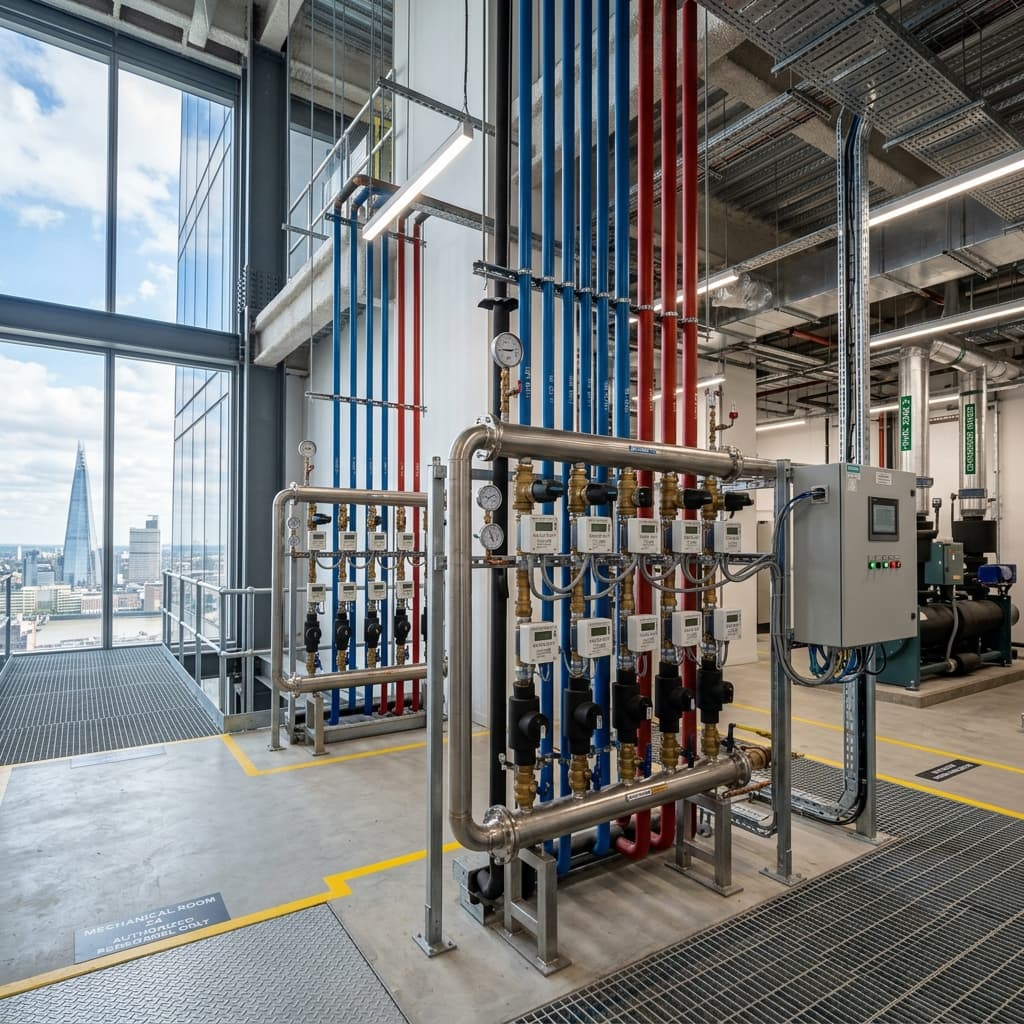
Commercial Tenant Submetering & Leak Defense
Accurately bill commercial tenants and catch pipe leaks with the meter's next daily report. Direct cellular telemetry with zero IT infrastructure or firewall setup.
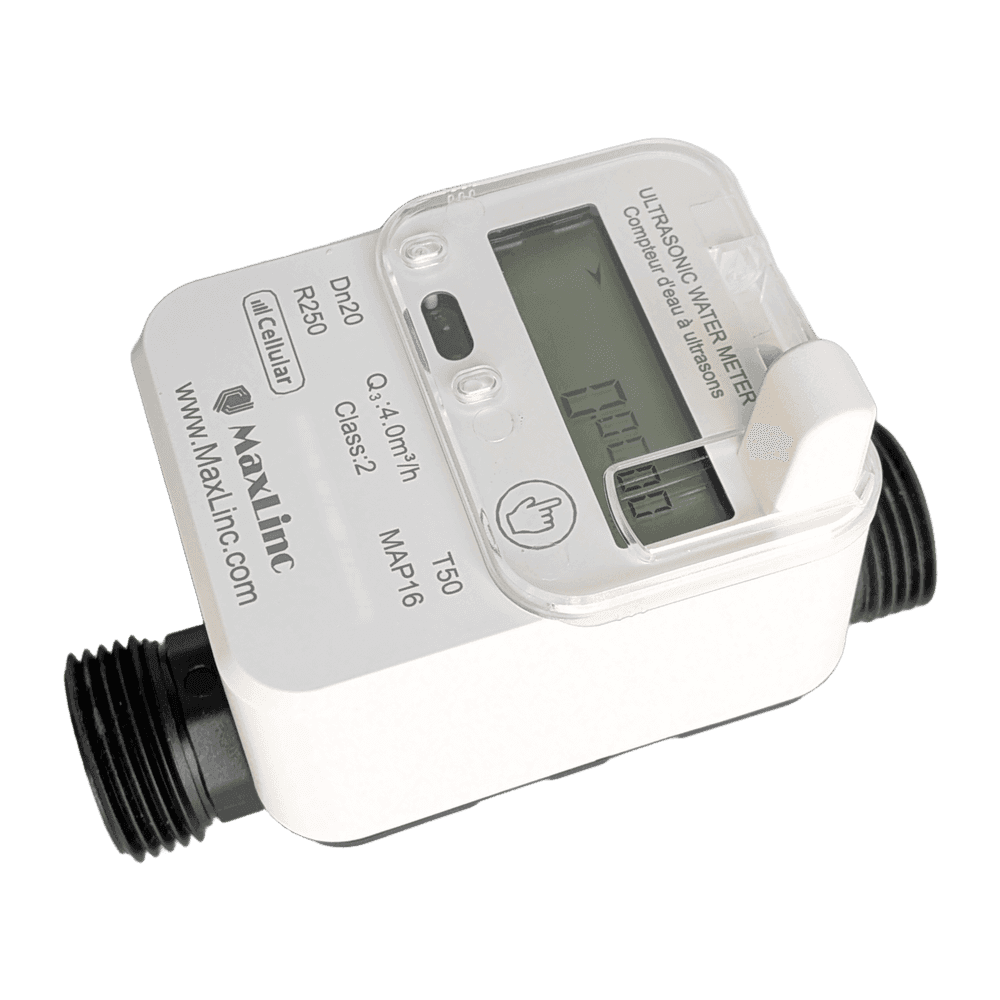
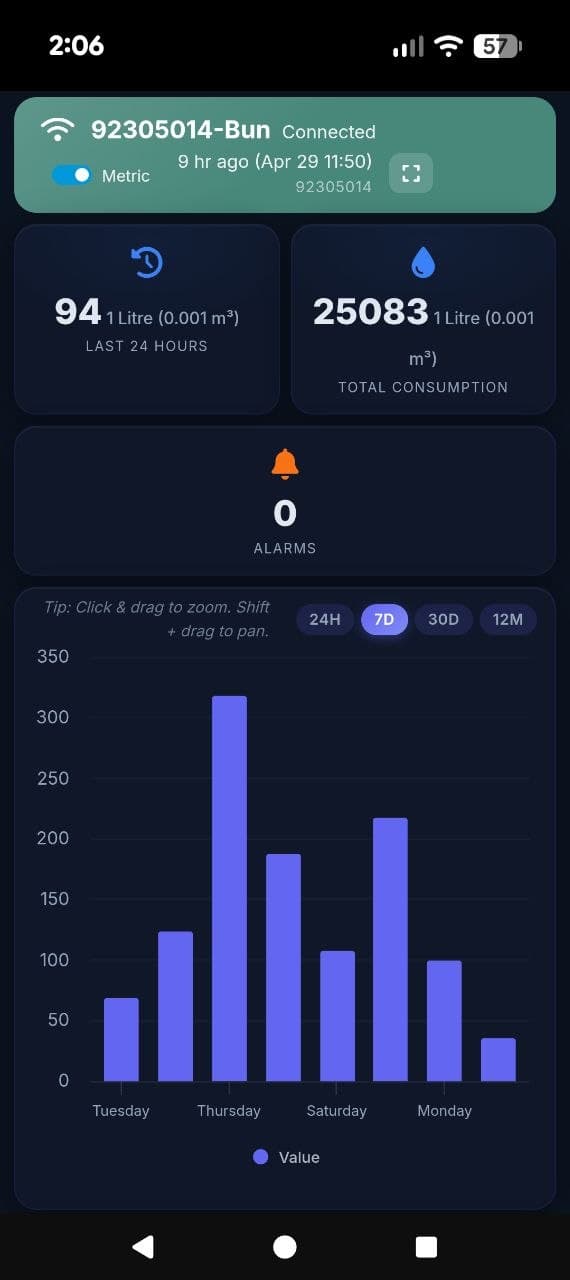
Zero site IT, zero customer WiFi needed. Readings transmit over cellular straight to your phone & tablet.
One roof, five completely different water tenants
In a strip mall or a mixed-use plaza, the spread between your heaviest and lightest unit is not a rounding error. Allocating that spread by leasable area charges the wrong tenants and starts the wrong arguments.
Full-service restaurant
Dish pits, prep sinks, ice machines, mop sinks, floor drains — running from open to close, every day you are open.
Salon, barber & spa
Wash stations run for a large share of the working day. Small footprint, steady draw.
Laundromat & dry cleaner
Here water is the process, not an amenity — which is why floor area tells you less about this tenant than about any other.
Dry retail & professional office
A washroom and a mop bucket. Charging this tenant by floor area is where the dispute starts.
Landscaping & common areas
Irrigation, pressure washing and lot maintenance are the landlord's own consumption — and they belong in a different line.
None of the numbers above are ours to publish — every plaza is different. That is exactly the point: the only honest way to know your spread is to measure it.
Two ways to allocate the same water bill
Nothing about the water changes. What changes is whether you can show a tenant where their number came from.
Allocation by leasable area
- The restaurant and the accountant's office pay the same rate per square foot
- A leak inside one unit is spread silently across every tenant, including the ones who did not cause it
- Nothing to show a tenant who disputes their share
- A vacancy re-cuts everyone's percentage with no relationship to use
- Your own irrigation and common-area water sits inside the tenants' pool
Allocation by measured consumption
- Each unit's share comes from its own meter, on its own record
- A continuous overnight flow raises a flag against one unit, the week it starts
- Every invoice line traces back to a dated reading you can export
- A vacant unit reads near zero without a formula change
- Landscaping and common-area draw gets its own meter and its own line
Measuring does not by itself give you the right to bill anyone. Read the lease and jurisdiction section below before you change how a tenant is charged. Before you change how a tenant is charged
It never touches your tenants' IT
This is the objection that kills most commercial submetering projects, and it is the reason this architecture exists. There is nothing to ask a tenant for.
No tenant network, ever
Each meter carries its own managed SIM and reports over cellular. No WiFi credential, no guest network, no jack in the leased premises.
No firewall change to negotiate
Nothing to route through a tenant's router or POS network, so there is no IT ticket, no vendor security review and no franchisee approval to wait on.
No gateway, no repeaters, no head-end
There is no building network layer to buy, power, permit or replace. Add a unit next year and it is one meter, not a redesign.
Survives tenant turnover
The meter belongs to the building. When a unit changes hands, nothing has to be re-paired, re-provisioned or re-approved by the incoming tenant.
Practically: a tenant who refuses to share a WiFi password, a franchise brand that forbids third-party devices on the store network, and an IT-free tenant are all the same easy case here.
From meter reading to CAM reconciliation
The output is a file, not a portal you have to live in. Whatever runs your operating-cost recovery, this fits underneath it.
Meters report on their own
Every unit meter uploads its totals over cellular on a schedule. No site visit, no reading route, no estimated line.
You pick the period
Daily, weekly, monthly, quarterly, annual or a rolling window — including a mid-month date when a lease turns over.
Export Excel
One file, one row per meter per period, with dated readings and the consumption between them.
Reconcile against the utility bill
Compare the sum of your submeters to the incoming municipal bill and see the gap — common-area draw, irrigation, or a loss you did not know about.
What the export actually gives you
The file is designed to be pasted into whatever you already reconcile in — a spreadsheet model, a property management package, or your accountant's working papers. There is no integration project and no per-seat licence to buy.
- Per-meter, per-period consumption with the start and end reading behind it
- Any period you choose, including partial periods for a mid-term lease change
- Unlimited users at no cost — give your bookkeeper, your property manager and your on-site staff their own logins
- Bulk-meter reconciliation: the sum of the submeters against the municipal bill, so unallocated water shows up as a number
The bill you are absorbing is going up
Commercial water and sewer rates are set municipally and they have been rising. Every one of these is a published 2026 figure.
increase in combined water, wastewater and stormwater rates
City of Calgary, 2026
rate increase approved, effective April 1, 2026
City of Ottawa, 2026
Block 1 water and wastewater rate when paid on time
City of Toronto, 2026
What one running fixture costs you
A toilet or urinal running at roughly 1 L/min (0.26 US gal/min) wastes about 525 m³ (139,000 US gal) over a year. At Toronto's 2026 Block 1 rate of $4.8629/m³, that is roughly $2,500 — from one washroom, in one unit, on a bill you pay and the tenant never sees. Under area-based allocation it is invisible until the bill arrives. Under measured allocation, it shows up as flow that never returns to zero overnight.
Arithmetic from the published Toronto 2026 rate. Your own rate, and therefore your own number, will differ.
Commercial Strip Mall & Retail Submetering
Meter each tenant space on independent cellular telemetry. Export monthly usage to Excel for fair CAM allocation.
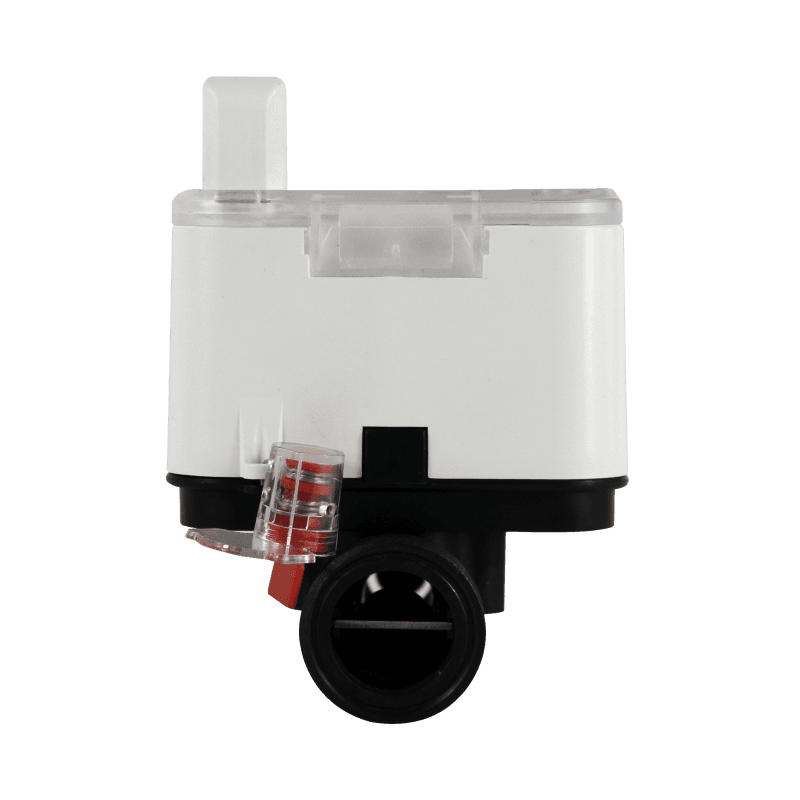
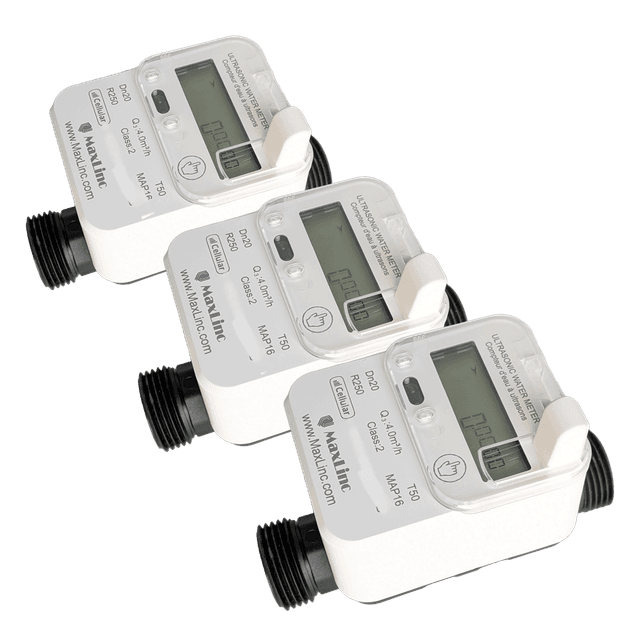
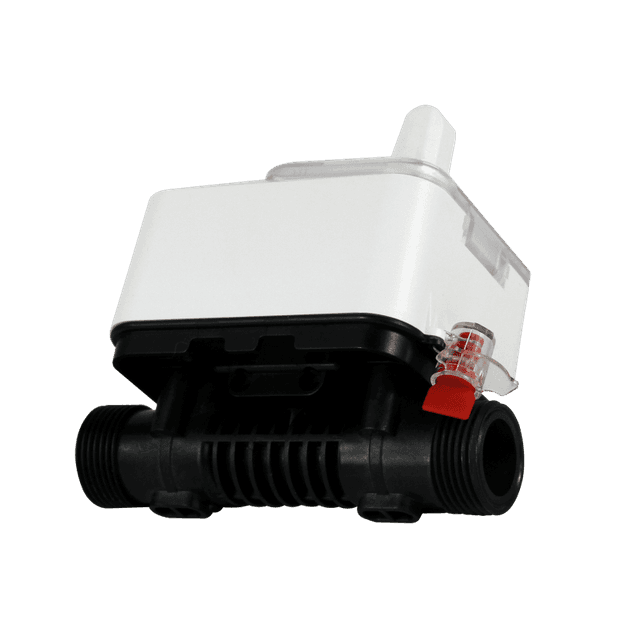
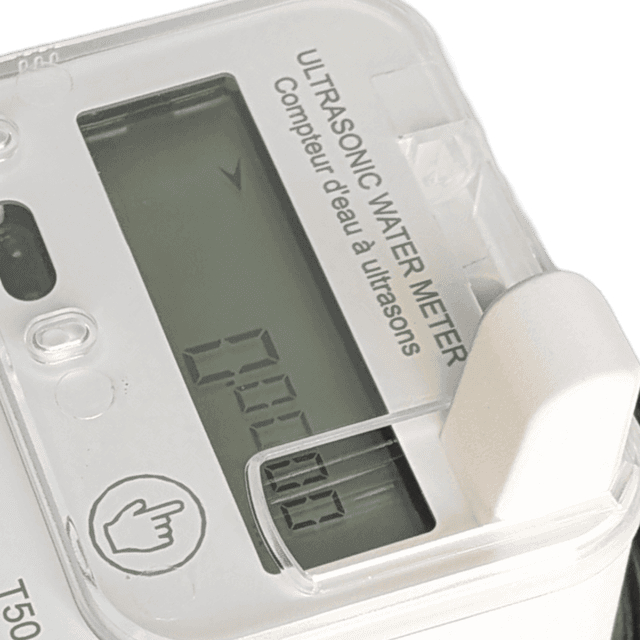
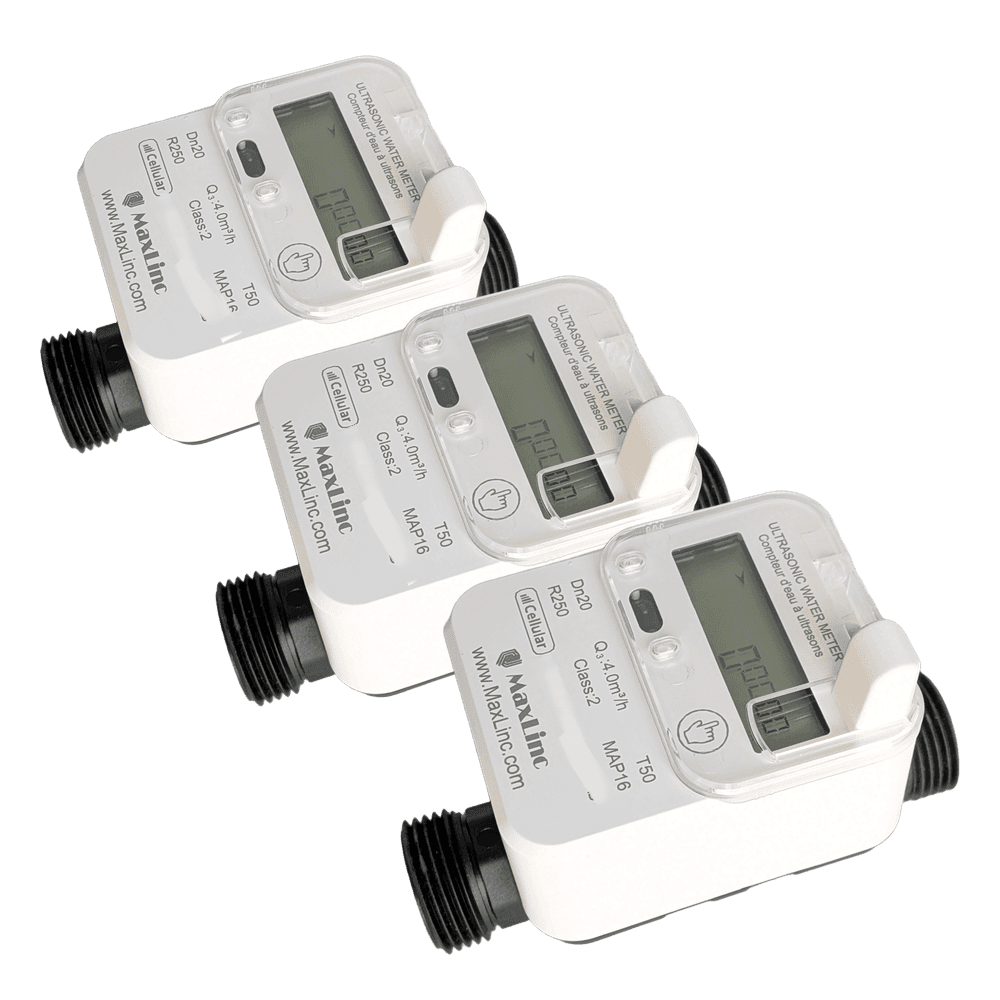
MaxLinc Cellular Ultrasonic Water Meter
An ultrasonic transit-time meter with no moving parts, a sealed battery, and a managed SIM already inside. It goes on the branch line to a commercial unit and starts reporting on its own.
No moving parts
Ultrasonic transit-time sensing — no piston, disc or turbine in the water to jam, wear or seize in a hard-water plaza.
Sized for branch lines
DN20 (3/4") and DN25 (1") — the sizes commercial unit feeds and irrigation branches are actually run in.
IP68, mechanical-room tough
Rated for submersion and buried installation, so a wet mechanical room, a floor drain backup or an outdoor pit is not a problem.
Micro-flow sensitivity
Starts registering at 2.5 L/h (0.66 US gal/h) on DN20 (3/4 in) — the range where a running fixture or a weeping valve lives.
Meter product pages:
Before you change how a tenant is charged
This is the part most vendors skip. Measuring water is available to you everywhere in Canada. Recovering the cost from an occupant is governed by the lease and by provincial law, and residential law is genuinely restrictive.
Commercial tenancies and residential tenancies are not treated the same way. A retail lease is largely a matter of what the parties agreed to in writing — typically an operating-cost or additional-rent clause. Residential tenancies are statutory, and several provinces restrict or cap what a landlord can recover for water regardless of what the lease says. If any part of your property is residential — the apartments above the storefronts in a mixed-use building are the common case — the residential rules apply to those units.
Ontario
- Monitor use, allocate internally, catch leaks
- Yes
- Recover water cost from a commercial tenant
- Generally per the lease's operating-cost terms
- Bill a residential tenant by consumption
- Limited — RTA s.137–138; apportioning capped at 6 units
British Columbia
- Monitor use, allocate internally, catch leaks
- Yes
- Recover water cost from a commercial tenant
- Generally per the lease's operating-cost terms
- Bill a residential tenant by consumption
- Terms must be in the tenancy agreement (RTB PG 22)
Quebec
- Monitor use, allocate internally, catch leaks
- Yes
- Recover water cost from a commercial tenant
- Generally per the lease's operating-cost terms
- Bill a residential tenant by consumption
- Restricted
Alberta
- Monitor use, allocate internally, catch leaks
- Yes
- Recover water cost from a commercial tenant
- Generally per the lease's operating-cost terms
- Bill a residential tenant by consumption
- By lease terms
| Ontario | British Columbia | Quebec | Alberta | |
|---|---|---|---|---|
| Monitor use, allocate internally, catch leaks | Yes | Yes | Yes | Yes |
| Recover water cost from a commercial tenant | Generally per the lease's operating-cost terms | Generally per the lease's operating-cost terms | Generally per the lease's operating-cost terms | Generally per the lease's operating-cost terms |
| Bill a residential tenant by consumption | Limited — RTA s.137–138; apportioning capped at 6 units | Terms must be in the tenancy agreement (RTB PG 22) | Restricted | By lease terms |
Mixed-use is where this goes wrong
Storefronts at grade with apartments above is the classic Canadian main-street building — and the classic mistake is applying one billing policy to the whole address. The commercial units follow the lease. The residential units follow provincial residential tenancy law, including the caps and conditions in the table above. Confirm your route for each half with your own counsel before you send an invoice.
- Do not assume a commercial clause carries over to the residential units in the same building. In a mixed-use property the two halves are governed separately.
- Nothing here is a Measurement Canada seal. Water meters are exempt from Measurement Canada's approval and initial inspection requirements, so no water meter sold in Canada carries one. What you rely on in a dispute is metrological performance and a dated, exportable record.
- Existing leases usually have to be amended at renewal rather than mid-term. Metering now and allocating at renewal is the common sequence.
- You do not need billing rights to benefit. Finding a leak, sizing a common-area line and separating your own irrigation draw are all available on day one.
Installing in an occupied plaza
It is a plumbing job on a branch line, not an IT project and not a tenant negotiation.
Find the branch
Each unit is usually fed from a branch off the main, often in a shared mechanical or service room. That branch, not the tenant's ceiling, is where the meter goes where the plumbing allows.
Isolate and fit
Close the shutoff either side, drain the line, and thread the meter in with the flow arrow pointing downstream. Horizontal or vertical upward both work.
Check the signal before you close up
The display has a signal screen. A deep vault or a steel-lidded pit can block cellular — confirm before the lid goes back on.
It is already online
No pairing, no configuration, no network to join, nothing to ask the tenant for. The cellular link starts on its own.
Most customers use their own plumber or mechanical contractor. There is no commissioning visit and no site network to configure. Send us a riser or service diagram for the plaza and we will come back with a per-unit estimate of what is meterable and what is not.
Typical time per meter: under an hour once the line is isolated.
Honest limit: these are DN20 (3/4") and DN25 (1") meters. They fit unit branch lines, irrigation feeds and deduct meters. They do not fit a large incoming main service. Tell us your line sizes and we will tell you which units we can meter and which we cannot.
Where a branch is only reachable inside the leased premises, you will need the access provision in the lease and a scheduled visit. Plan that unit around the tenant's slow day rather than assuming a refusal.
Specifications
Enough to hand to a mechanical contractor or drop into a scope of work.
- Measurement
- Ultrasonic transit-time — no moving parts, piezoelectric ceramic transducer
- Accuracy
- Class 2 — ±5% in the low zone (Q1 ≤ Q < Q2), ±2% in the high zone (Q2 ≤ Q ≤ Q4)
- Metrological range
- R250 standard, R400 available
- Flow-field sensitivity
- U0/D0
- Permanent flow (Q3)
- 4.0 m³/h (17.6 US gal/min) on DN20 (3/4 in) · 6.3 m³/h (27.7 US gal/min) on DN25 (1 in)
- Overload flow (Q4)
- 5.0 m³/h (22.0 US gal/min) on DN20 (3/4 in) · 7.875 m³/h (34.7 US gal/min) on DN25 (1 in)
- Start flow
- 0.0025 m³/h (2.5 L/h, 0.66 US gal/h) on DN20 (3/4 in) · 0.004 m³/h (4 L/h, 1.06 US gal/h) on DN25 (1 in)
- Resolution
- 0.0001 m³ (0.1 L, 0.03 US gal)
- Metering
- Two-way, with reverse-flow detection
- Max pressure
- MAP16 — 16 bar (232 psi), pressure loss class Δp63
- Water temperature
- 0.1–50 °C (32–122 °F), class T30/T50
- Operating ambient
- −25 to +55 °C (−13 to +131 °F)
- Ingress protection
- IP68 — submersible / buried
- Onboard storage
- 24 months of frozen historical data plus the last 36 days
- Fault detection
- Low battery, reverse flow, over-range, empty pipe, pipe burst, leak, over-temperature
- Display
- Multi-view LCD with a single touch button
- Connectivity
- Cellular, built-in eSIM, unlimited international data
- Battery
- Sealed 3.6 V lithium, more than 6 years
- Installation
- Horizontal or vertical upward
- Sizes
- DN20 (3/4 in, 1" NPSM thread) · DN25 (1 in, 1¼" NPSM thread)
Full dimensions, flow curves and installation guidance are in the user manual.
What commercial landlords ask us first
Can I actually bill my commercial tenants for their water?
For a commercial tenancy this is generally a question of what your lease says — the recovery mechanism is usually the operating-cost or additional-rent clause, and most leases have to be amended at renewal rather than mid-term. It is a different question for residential units: several provinces restrict or cap what a landlord can recover for water regardless of the lease, so if your property is mixed-use, the apartments above the storefronts follow provincial residential tenancy law. Confirm both halves with your own counsel. What is available everywhere, today, is measuring: seeing which unit uses what, catching a leak, and separating your own common-area draw.
Do I need my tenants' WiFi, or access to their network?
No — and this is the whole design. Each meter has its own managed SIM and reports over cellular. There is no WiFi password to collect, no firewall rule to request, no guest network to be added to, no device on a tenant's point-of-sale network, and no franchise IT approval to wait for. A tenant with no IT at all and a national brand that forbids third-party devices on the store network are equally easy cases.
A tenant will not let a contractor into their space. Now what?
In most plazas the unit branch comes off the main in a shared mechanical or service room, so the meter goes there rather than inside the leased premises. Where a branch is only reachable inside the unit, you will need the access provision in your lease and a scheduled visit — plan it around the tenant's slow day. Send us a service diagram and we will tell you which units look meterable from common space and which do not.
How does this get into my CAM reconciliation?
As a file. Choose any period — including a partial one when a lease turns over mid-month — and export to Excel with one row per meter, the start and end readings and the consumption between them. Paste it into whatever you reconcile in today. There is no integration project, and your bookkeeper gets their own login at no extra cost.
What happens when a tenant disputes an invoice?
You have a dated meter record for that unit that you can export and show, rather than a percentage of floor area. Be straight about one thing though: no water meter sold in Canada carries a Measurement Canada seal, because water meters are exempt from Measurement Canada's approval and initial inspection requirements. If a vendor tells you theirs is certified, ask for the document. What you rely on is metrological performance — accuracy class 2, range R250 — and the record.
What size are the lines in a typical strip mall — will these fit?
These are DN20 (3/4") and DN25 (1") meters, which is the size range unit branch lines and irrigation feeds are commonly run in. They do not fit a large incoming main service. Send us your line sizes and we will tell you honestly which units we can meter and which we cannot, rather than sell you the wrong meter.
What happens when a unit turns over?
Nothing has to be re-provisioned. The meter belongs to the building, not the tenant, and it keeps reporting through the vacancy — a vacant unit simply reads near zero. Take an export dated to the changeover and you have the closing number for the outgoing tenant and the opening number for the incoming one.
The mechanical room is a concrete box with a steel door. Will it have signal?
Check before you close it up — the meter has a signal screen on its display. Deep vaults, steel lids and heavily shielded rooms can block cellular, so the meter wants to be near grade and away from a full metal enclosure. Send us an address list and we will run a coverage check before you order anything.
What does it cost after we buy?
Nothing for the first 5 years: there is no subscription fee, and the built-in eSIM includes unlimited international data, so there is no carrier bill coming to you and no data plan to renew. From year 6 it is about $8.89 a year per meter (about 74¢ a month), billed annually, for the data plan, the app and Canadian cloud hosting. No contract, and no share of anything you recover.
Where is the consumption data stored?
In Canada. MaxLinc is a Canadian company with Canadian support, and your consumption data is hosted in Canada.
Do these replace the utility's meter?
No. The municipal meter on your incoming service stays exactly where it is and keeps producing the bill you pay. These are submeters downstream of it, which is what lets you compare the sum of your units against the utility's number and see what is unallocated.
How long does the battery last, and what happens at the end of it?
The battery is a sealed 3.6 V lithium cell rated for more than six years, and you get a low-battery alert well ahead of time, which makes it planned work in your capital plan instead of an outage. It is sealed because the meter is IP68: it can be replaced (replacement battery CAD 59), but that means breaking the factory seal, so contact support first.
Speak to a commercial submetering specialist
Tell us how many units you have and what the plaza looks like. You will get a straight answer on which units are meterable, per-meter pricing at your quantity, and what it costs to run.
Request volume pricing
No account, no obligation. If your lines are the wrong size for these meters we will tell you that instead of quoting you.
This is one use for the same meter
Commercial and retail submetering is one segment. The same cellular meter and the same app are used for condo and strata suites, rental buildings, municipal systems, parks and remote sites — with the full specification, the province-by-province billing panel, grant programs and installation detail on the main water metering page.
See the full cellular water metering pageStart with one plaza, not a portfolio
Meter the units you already suspect, run a full quarter, and look at the spread against what floor area said it should be. If the two agree, you have learned that cheaply.
MaxLinc Technology Solutions Inc., Vancouver BC. Canadian company, Canadian support, cloud hosted in Canada.