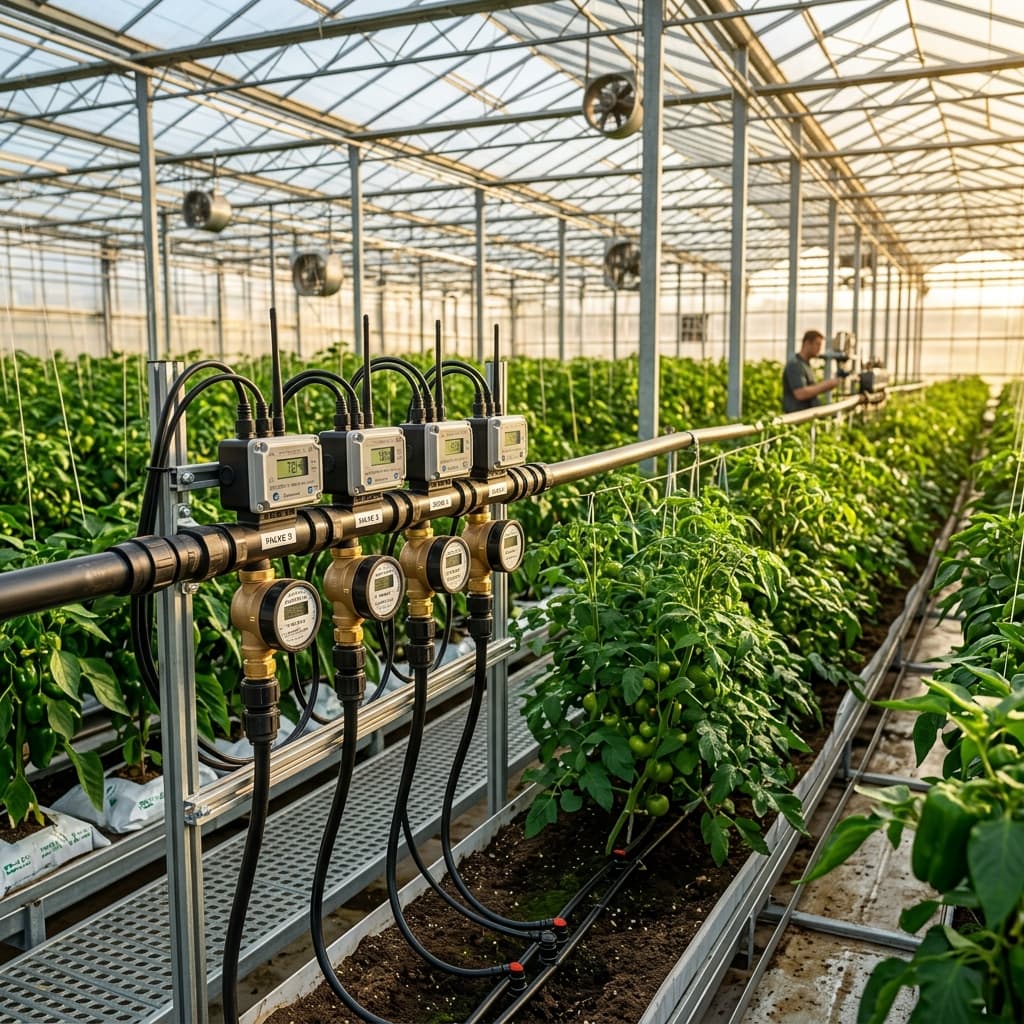
IP68 Irrigation & Greenhouse Water Submetering
Track irrigation flow across drip blocks, greenhouses, and remote valve pits. Submersible IP68 cellular meters transmit direct telemetry with zero field network setup.
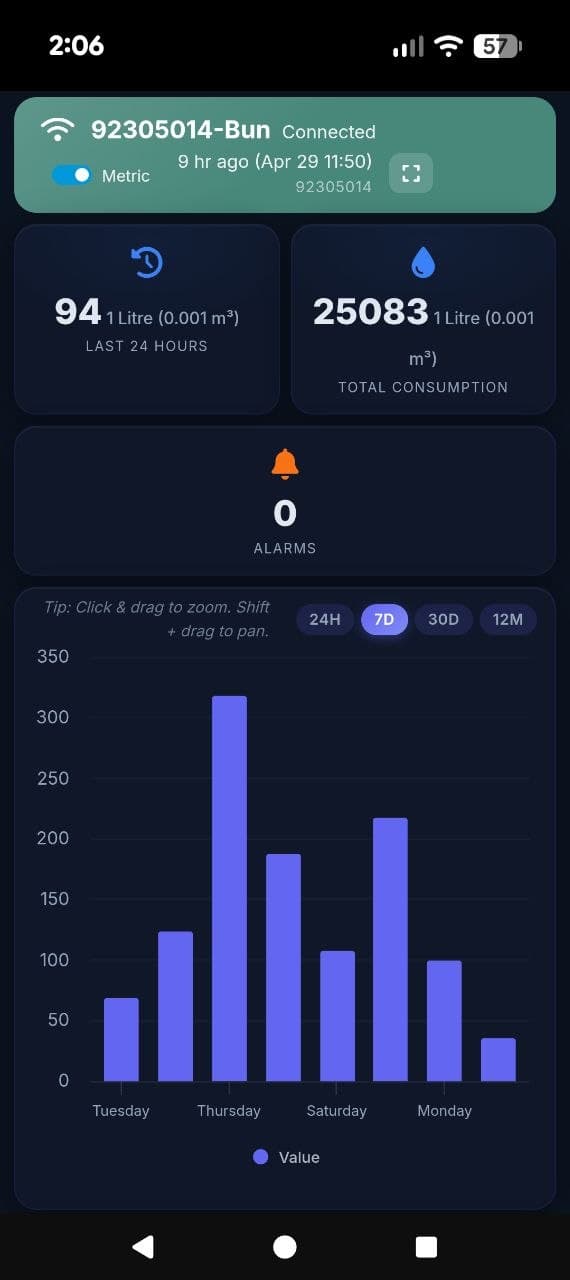
Zero site IT, zero customer WiFi needed. Readings transmit over cellular straight to your phone & tablet.
Six places on a farm where water data is genuinely hard to get
Different crops, different plumbing, the same problem: the water is measured somewhere nobody can reach. Jump to yours.
Not for you if what you need is a meter on your licensed intake. That pipe is almost certainly bigger than 1 inch, and we would rather tell you now than after you have bought something.
There is no network to build at the end of a lateral
Farm telemetry rarely fails on the sensing. It fails on infrastructure — power, mounting, backhaul and the person who has to keep all three alive. Those are the expensive parts, and they are the parts that break. This meter carries its own.
The usual way to get water data off a farm
- 1Flow sensor
- 2Pulse cable
- 3Datalogger
- 4Solar panel & battery
- 5Gateway or telemetry radio
- 6Somebody’s laptop
Six things that can fail in a field — and every one of them is yours to mount, power, permit, service and eventually replace.
The MaxLinc way
- 1Meter in the line
- 2Cellular
- 3Canadian cloud
- 4Your browser
Nothing between the pipe and your dashboard that you have to buy, power or maintain.
Built for the wet, cold, unpowered end of the operation
Not because we call it rugged. Because of four ratings you can check on the datasheet before you believe us.
IP68 — rated for submersion
Flooded valve boxes, irrigation pits, buried chambers, wash-down bays and a greenhouse floor that is wet by design. Condensation is not a serious threat to a body rated to sit underwater.
−25 to +55 °C (−13 to +131 °F) ambient
An unheated outbuilding, a valve box in full August sun, a pump house in January. The ambient band covers the shoulder seasons a farm actually runs in. Water left inside the meter is a separate problem — see installation.
No power at the meter
A sealed 3.6 V lithium battery rated for more than six years. No mains run to trench, no solar panel to mount and clean, no charge controller to fail in the cold.
No moving parts
Ultrasonic transit-time sensing with a piezoelectric ceramic transducer. No piston, disc or turbine sits in the water, so there is nothing for grit, biofilm or hard water to jam or wear out.
The leak you cannot hear, on a line nobody walks
Bursts get found. It is the drip that runs all season that nobody catches.
A DN20 (3/4 in) meter starts registering at 2.5 L/h (0.66 US gal/h) and resolves to 0.1 L (0.03 US gal). That resolution is not for the burst — you find those eventually, usually by standing in them. It is for the weeping valve, the emitter that never seated, the split lateral under a cover crop and the float that stuck open in a waterer in the far barn. Small, continuous and completely silent until the bill arrives.
What a continuous flow adds up to
A weeping valve right at the meter’s 2.5 L/h (0.66 US gal/h) start flow
- Arithmetic
- 2.5 L/h (0.66 US gal/h) × 24 h
- If it runs all year
- 60 L (16 US gal) a day · 21.9 m³ (5,790 US gal) a year
One 4 L/h (1.06 US gal/h) emitter left open
- Arithmetic
- 4 L/h (1.06 US gal/h) × 24 h
- If it runs all year
- 96 L (25 US gal) a day · 35 m³ (9,250 US gal) a year
A split lateral passing 60 L/h (16 US gal/h)
- Arithmetic
- 60 L/h (16 US gal/h) × 24 h
- If it runs all year
- 1.44 m³ (380 US gal) a day · 43 m³ (11,400 US gal) in a month
| The flow | Arithmetic | If it runs all year |
|---|---|---|
| A weeping valve right at the meter’s 2.5 L/h (0.66 US gal/h) start flow | 2.5 L/h (0.66 US gal/h) × 24 h | 60 L (16 US gal) a day · 21.9 m³ (5,790 US gal) a year |
| One 4 L/h (1.06 US gal/h) emitter left open | 4 L/h (1.06 US gal/h) × 24 h | 96 L (25 US gal) a day · 35 m³ (9,250 US gal) a year |
| A split lateral passing 60 L/h (16 US gal/h) | 60 L/h (16 US gal/h) × 24 h | 1.44 m³ (380 US gal) a day · 43 m³ (11,400 US gal) in a month |
This is straight arithmetic from the meter’s published start flow — multiply it out yourself. What it costs you depends on your water rate, your source, your crop and how long it runs before someone notices, so we are not going to put a dollar figure or a payback period on it. Anyone who promises you one has not seen your operation.
The honest limit: below 2.5 L/h (0.66 US gal/h) on a DN20 (3/4 in) the meter does not register, and no meter of this class does. In practice that means a leak has to be smaller than roughly 60 litres (16 US gal) a day before it is invisible to you.
Faults the meter raises on its own
Not thresholds somebody had to guess in advance. These are conditions the meter detects and reports itself.
Pipe burst
A lateral lets go at two in the morning in a block nobody walks until Thursday. The meter flags the event rather than leaving you to find the water.
Leak
Continuous flow on a line that should have shut off hours ago. The classic weeping valve, split drip line or stuck float.
Empty pipe
The line has lost prime or a pump is drawing air. A mechanical meter reads zero here and tells you nothing at all.
Reverse flow
Water moving the wrong way — a cross-connection pulling backwards, or a return leg plumbed against the arrow.
Over-range
Flow past the meter’s rated maximum. Usually the first sign something downstream opened that should not have.
Over-temperature
Water outside the rated 0.1–50 °C (32.2–122 °F) band.
Low battery
Raised well ahead of end of life, so a swap is a scheduled job rather than a gap in your records.
On top of the meter’s own faults you can set unlimited consumption alarms per meter or per group — weekly, monthly, yearly or a rolling window. Alerts reach the app and your email.
Where this meter belongs — and where it does not
The second list is the more useful one. Read it before you order.
Good places to put it
- Zone and lateral feeds — the 3/4" or 1" line at the head of a drip block, greenhouse bay or bench run.
- Clean supply upstream of injection — the line before your fertigation or acid dosing tees in. Same volume number, none of the risk.
- Recirculation and return legs — two-way metering means the return is measured rather than assumed.
- Barn, dairy and livestock waterer lines — laterals that have never had a number on them.
- Wash-down, packhouse and greenhouse service lines — real volume, almost never metered.
- Frost-protection and misting lines — a very large draw in short windows, completely invisible on a seasonal bill.
Where we are the wrong meter
- Your licensed point of diversion. An intake, well head or pump discharge is almost always far bigger than a 1" line. See the licensing section below — we are not your intake meter.
- Downstream of nutrient or acid injection. We do not publish a chemical-compatibility rating for injected solution, so we will not tell you it is fine. Meter the clean side, or send us the chemistry and get a straight answer.
- Anything above 1". DN20 and DN25 only. Tell us your pipe size and we will tell you honestly whether we fit.
- Water outside 0.1–50 °C (32.2–122 °F). That is the rated water temperature range — steam, glycol loops and heated process water are out.
- Lines you leave charged over winter. Ambient is rated to −25 °C (−13 °F), but water left inside will freeze and split any meter, ours included.
If you are unsure which side of these lists you are on, send us a sketch of the line and the size. A short honest no costs us far less than a return.
Greenhouse & Irrigation Zone Metering
IP68 submersible ultrasonic flow detection for drip blocks, greenhouses, and remote valve pits. Sealed 6+ year battery.
 The product
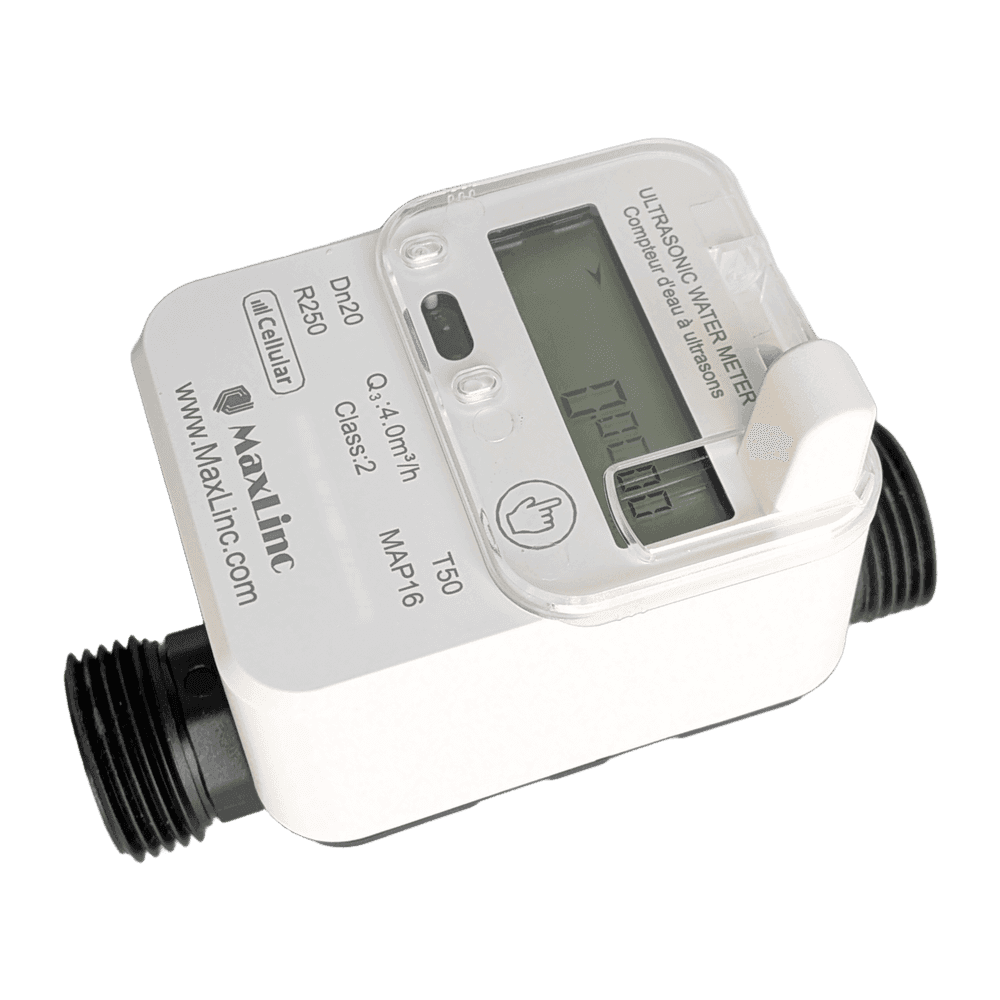
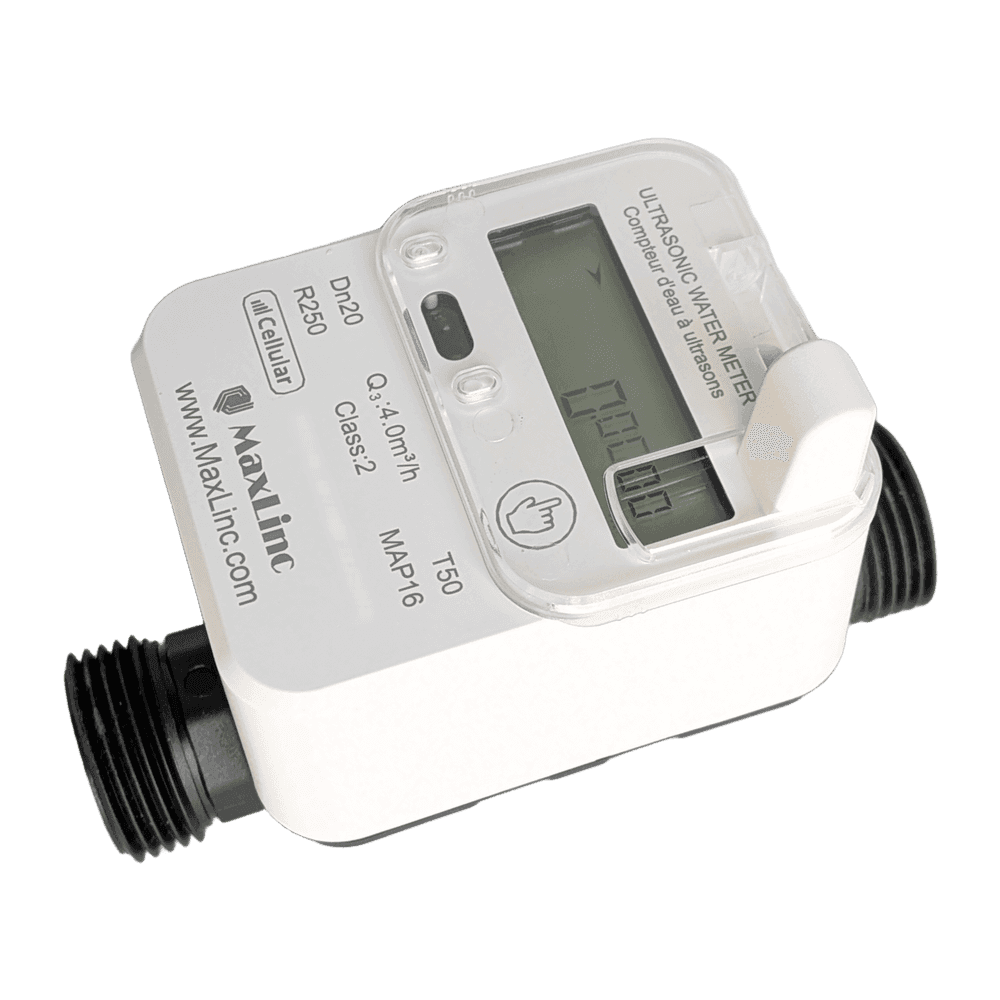
MaxLinc Cellular Ultrasonic Water Meter
A no-moving-parts ultrasonic meter with an IP68 body, a sealed battery rated for more than six years and a managed SIM inside. Class 2 accuracy, U0/D0 flow-field rating, two-way metering, and onboard fault detection for burst, leak, empty pipe and reverse flow.
One-time purchase per meter. No subscription fee for the first 5 years: the data plan, the app and Canadian cloud hosting are included. From year 6 it is about $8.89 a year per meter (about 74¢ a month), billed annually. The built-in eSIM includes unlimited international data. No contract.
Buy DN25The meter is the sensor. The app is the product.
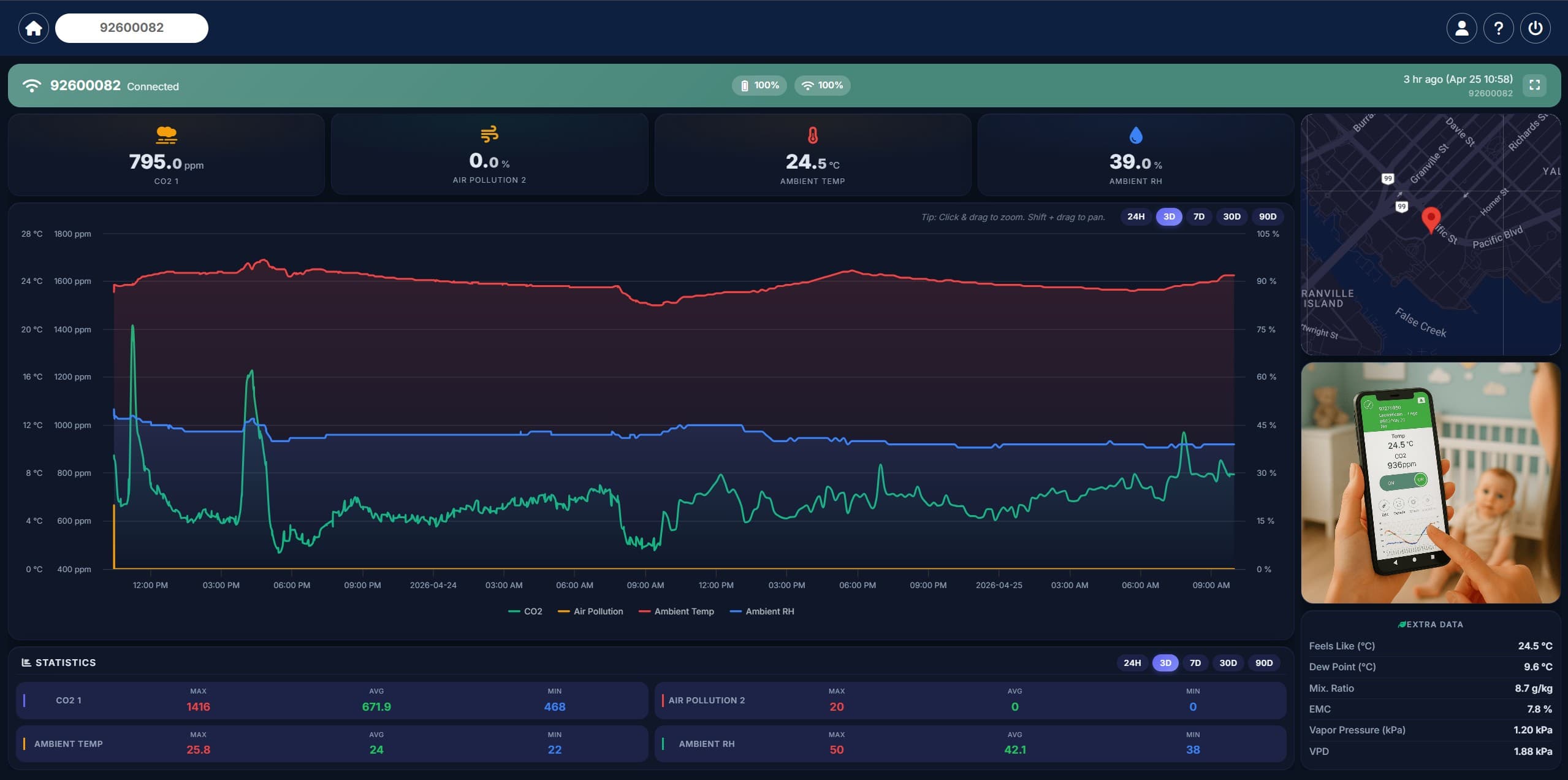
Per-zone volume, exports, alarms and 24 months of history — without a controller, a laptop in the pump house or a site visit.
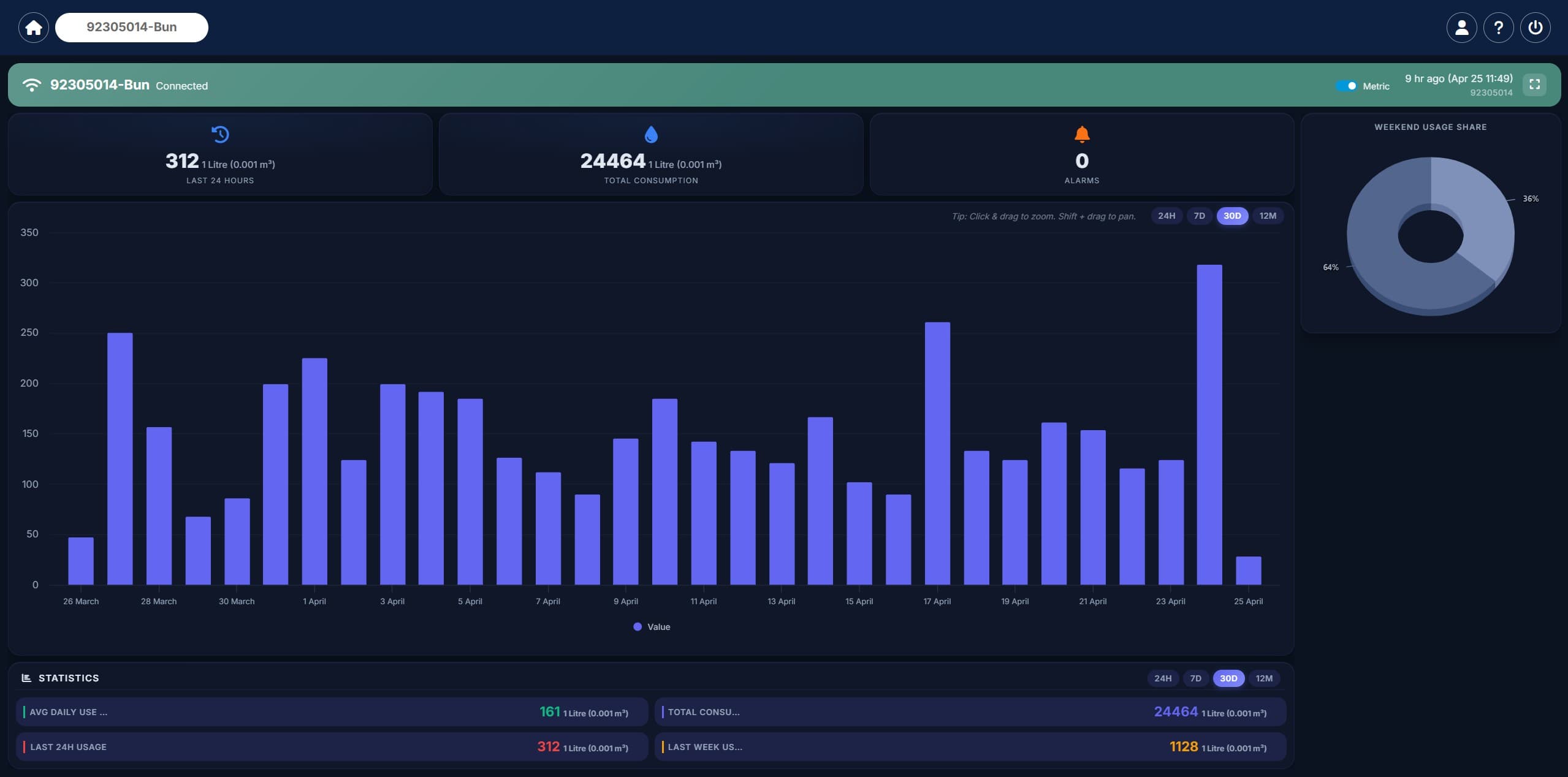
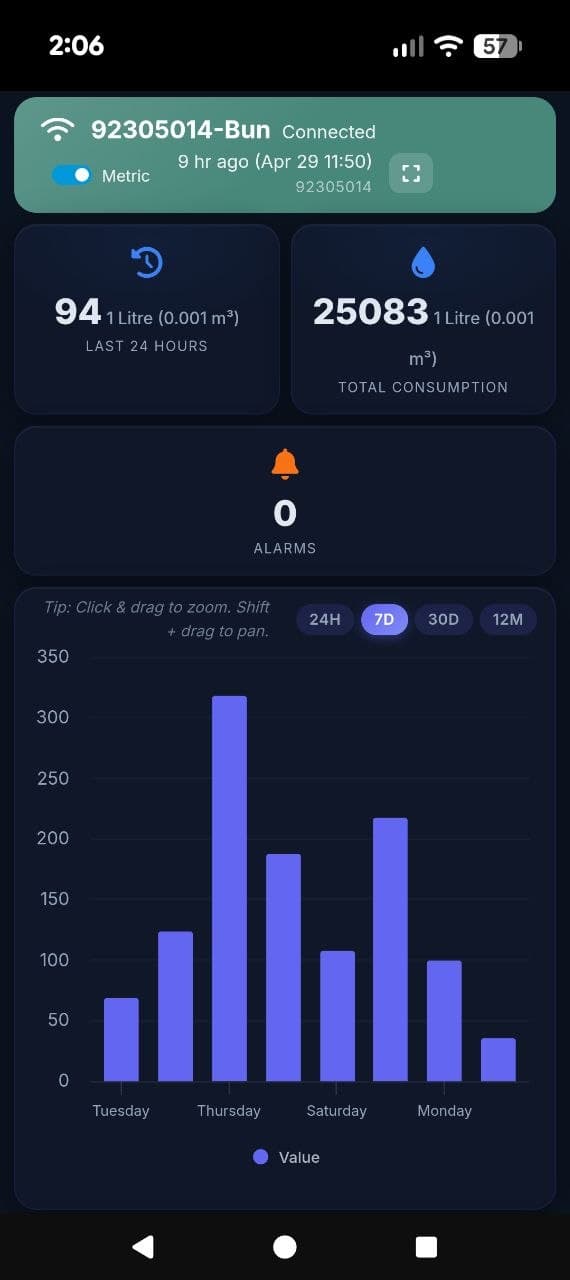
Automatic remote reads
No walking the property, no clipboard, no estimated numbers. Every meter reports its totals over cellular on a schedule.
Per-zone and per-block ranking
Sort every zone, bay, block, barn or lateral by consumption and find your worst one in seconds.
Continuous-flow and leak alerts
When flow on a line never stops, you get told. A wide-turndown ultrasonic meter sees the trickle a mechanical meter misses entirely.
Smart anomaly detection
The system learns each meter’s normal irrigation pattern and flags unusual use — the leak nobody thought to set a threshold for.
Custom consumption alarms
Weekly, monthly, yearly or rolling-window limits. Unlimited rules, per meter or per group of meters.
Reports and Excel export
Daily, weekly, monthly and yearly reports you can view, share or export to Excel for your farm plan, agronomist or accountant.
24 months on the meter itself
The meter stores 24 months of frozen historical data plus the last 36 days on board — so a gap in coverage is a delay, not a hole in your records.
No-upload and device-error alerts
You learn that a meter in a far paddock went quiet that week. You do not discover it at spring startup.
Unlimited users, no per-seat fee
Give your irrigation manager, agronomist, contractor and bookkeeper their own login. There is no seat count to buy.
Your consumption data is stored in Canada.
Water metering for greenhouses, hydroponics, orchards, fields, districts and barns
The same meter and the same app. Six very different plumbing problems.
Per-bay and per-bench water, in a building where the floor is wet on purpose.
IP68 is a submersion rating, so 100% relative humidity, a wet floor and condensation running off a header are not a hard environment for this body. Ambient is rated −25 to +55 °C (−13 to +131 °F), which covers an unheated end bay and a summer roof space. Start flow on DN20 (3/4 in) is 2.5 L/h (0.66 US gal/h) with 0.1 L (0.03 US gal) resolution — bench-run scale, not main-line scale.
“My feed line is fertigated. Will it survive nutrient solution?”
We will not tell you it will, because we do not publish a chemical-compatibility rating for injected solution and we are not going to invent one. Meter the clean supply upstream of your injection point and you get the same volume number with none of the risk. If you genuinely need metering downstream of the dosing skid, send us the chemistry and concentration and you will get a straight yes or no.
Measure what goes out and what comes back. The return leg is half the number.
The meter is two-way with reverse-flow detection, so a recirculating loop can be metered on both legs instead of estimated on one. Resolution is 0.1 L (0.03 US gal), start flow on DN20 (3/4 in) is 2.5 L/h (0.66 US gal/h), and 24 months of history sits on the meter itself.
“I already have flow sensors on my controller.”
Then you have instantaneous flow, inside the controller, when somebody is looking at it. This is a totalising meter with its own stored history and its own way out of the building — it keeps counting when the controller is down or being replaced, and the record survives both. Most operations run both and use this one as the number they trust at year end.
Block-by-block water on a property where the nearest outlet is a kilometre away.
A sealed 3.6 V lithium battery rated for more than six years, and an eSIM with unlimited international data. No power run, no solar panel on a post, no gateway, no radio network to own and re-permit.
“Half my valve boxes are underwater every spring.”
IP68 — rated for submersion and buried installation. The thing to watch on a farm is not water, it is signal: a steel lid, a deep vault or a wet concrete chamber can block cellular. Keep the meter near grade and check the signal screen before you close the box.
The far corner of the quarter section, where nothing reaches and nobody drives in February.
No mains power, no WiFi, no gateway and no site IT. The meter reports over its own managed SIM. If one goes quiet, a no-upload alert tells you that week rather than at spring startup.
“It is going to freeze out there.”
Ambient is rated −25 to +55 °C (−13 to +131 °F), and a drained meter left in place keeps reporting its status all winter. But water left inside a charged line will freeze and split any meter, ours included. Winterize the line the way you already do at shutdown — that part does not change because the meter is smart.
Turnouts and small service connections metered without building a radio network first.
Because there is no collector layer, no backhaul and no head-end server to amortise, your cost per meter is the same at 20 meters and at 2,000. Unlimited users means every operator, clerk and board member gets a login at no extra cost.
“Most of our connections are bigger than 1 inch.”
Then most of them are not ours, and we would rather say so before you write a spec around us. DN20 and DN25 fit 3/4" and 1" service lines — small turnouts, stock and yard services, sub-laterals and domestic connections. Send us your size distribution and we will tell you what share of your system we can actually meter and what share you will need somebody else for.
A waterer line you have never had a number for, in a building nobody is metering.
Fits the 3/4" and 1" laterals that feed waterers, wash-down bays and parlour service. IP68 handles wash-down and a wet floor. Continuous-flow detection catches a float that stuck open, which is the failure mode nobody sees until the bill.
“Why would I bother metering a barn?”
Two reasons. A stuck float or a leaking waterer can run for weeks in a building people walk through daily, because running water in a barn is normal background noise. And daily consumption per line is a signal in its own right — herd water intake moves before a lot of other things do. You get a daily total per line and an alert when flow never stops.
Water licences, permits, and what this meter is not
The most common reason a grower goes shopping for a meter is a reporting obligation. Here is the answer that costs us the sale about half the time.
Licence and permit conditions are normally written against your point of diversion — the intake, the well head or the pump discharge. That is almost always a pipe far larger than the 3/4" and 1" lines these meters fit. We are not the right meter for your intake and we are not going to pretend otherwise. What we are good at is everything downstream of it.
Measured at the point of diversion
If your condition names a diversion point, the meter has to go there and be sized for it. Ours is not. Ask us and we will say so on the phone rather than on the invoice.
Downstream is where we fit
Per-zone, per-block, per-house, per-barn and per-lateral consumption — the numbers your licence does not ask for and your agronomist actually wants.
Your records, exportable
Daily, weekly, monthly and yearly totals export to Excel for your own records, your environmental farm plan or a voluntary water-use report.
Ask your regulator, not your vendor
Whether a particular meter satisfies a particular permit condition is a question for the authority that issued it. We will give you the metrology in writing; they decide whether it counts.
Where to check your own obligation
Ontario — Permit To Take Water
In Ontario a permit is generally required to take more than 50,000 litres (13,200 US gal) of water per day from a lake, river, stream or groundwater, with exceptions. Confirm your own situation with the ministry.
www.ontario.caBritish Columbia — water licensing & rights
Under the Water Sustainability Act, non-domestic surface and groundwater use in BC generally requires a licence or approval. Check your status with the province.
www2.gov.bc.caSummary only, current to 2026, and not legal advice. Requirements vary by province, watershed, source and volume. Confirm yours with the authority that issued your licence or permit.
Agricultural water meter specifications
Everything your irrigation designer or consulting engineer needs to drop this into a drawing set.
- Measurement
- Ultrasonic transit-time, piezoelectric ceramic transducer — no moving parts
- Accuracy
- Class 2 — ±5% from Q1 to Q2, ±2% from Q2 to Q4
- Metrological range
- R250 standard (R400 available)
- Flow-field sensitivity
- U0/D0 — no straight-pipe run required upstream or downstream
- Q3 / Q4
- DN20 (3/4 in): 4.0 / 5.0 m³/h (17.6 / 22.0 US gal/min) · DN25 (1 in): 6.3 / 7.875 m³/h (27.7 / 34.7 US gal/min)
- Start flow
- DN20 (3/4 in): 2.5 L/h (0.0025 m³/h, 0.66 US gal/h) · DN25 (1 in): 4.0 L/h (0.004 m³/h, 1.06 US gal/h)
- Resolution
- 0.0001 m³ (0.1 L, 0.03 US gal)
- Metering direction
- Two-way, with reverse-flow detection
- Fault detection
- Pipe burst, leak, empty pipe, reverse flow, over-range, over-temperature, low battery
- Onboard storage
- 24 months of frozen historical data plus the last 36 days
- Water temperature
- 0.1–50 °C (32–122 °F), class T30/T50
- Max pressure
- MAP16 — 16 bar (232 psi). Pressure loss class Δp63
- Operating ambient
- −25 to +55 °C (−13 to +131 °F)
- Ingress protection
- IP68 — submersible / buried
- Connectivity
- Cellular, built-in eSIM, unlimited international data
- Battery
- Sealed 3.6 V lithium, more than 6 years
- Display
- Multi-view LCD, single touch button
- Orientation
- Horizontal or vertical upward
- Sizes
- DN20 — 1" NPSM thread, 3/4" line · DN25 — 1¼" NPSM thread, 1" line
Copy-paste specification
Water meter shall be an ultrasonic transit-time type with no moving parts, accuracy class 2 (±5% from Q1 to Q2, ±2% from Q2 to Q4), metrological range R250, flow-field sensitivity U0/D0 requiring no straight pipe run upstream or downstream, two-way metering with reverse-flow detection, resolution 0.0001 m³ (0.03 US gal), maximum admissible pressure MAP16 (16 bar, 232 psi), pressure loss class Δp63, water temperature range 0.1–50 °C (32.2–122 °F; class T30/T50), operating ambient −25 to +55 °C (−13 to +131 °F), ingress protection IP68 suitable for submersion and buried installation, onboard fault detection for pipe burst, leak, empty pipe, reverse flow, over-range, over-temperature and low battery, 24 months of stored historical data, integral cellular communication with a managed SIM requiring no external gateway or fixed network infrastructure, and a sealed 3.6 V lithium battery rated for more than 6 years. Sizes DN20 (3/4 in) and DN25 (1 in), installed horizontal or vertical upward.
Full dimensions, flow rates and installation guidance are in the user manual.
Installing a meter on an irrigation line
Short version: it is a plumbing job your irrigation contractor already knows how to do.
Pick the point
Choose the 3/4" or 1" line you actually want a number for — a zone feed, a lateral, a return leg, a barn line. U0/D0 means no straight-pipe run is required, so a tight header or a crowded valve box is fine.
Isolate and thread it in
Close the shutoff either side, drain the line, and thread the meter in with the flow arrow pointing downstream. PTFE tape or approved paste — never hemp. Horizontal or vertical upward.
Pressure-test and check signal
Restore flow, check for leaks and confirm the display wakes on a touch. Check the signal screen before you close a buried pit or a steel-lidded box.
It is already online
No pairing, no configuration, no network to join and nobody from IT. The cellular link starts on its own.
Most growers use their own irrigation contractor or plumber. There is no commissioning visit, no gateway to mount, no solar array to size and no site network to configure. If you would like an installer referral in your area, ask.
Typical time per meter: under an hour once the line is isolated.
Before you close a buried pit or a metal-lidded valve box, check the signal screen. A deep vault, a steel lid or a wet concrete chamber can block cellular — keep the meter near grade.
Winterizing is on you, and it is not optional. Ambient is rated to −25 °C (−13 °F), but water left inside a charged line will freeze and split any meter, ours included. Drain and blow out the way you already do at shutdown. A drained meter left in place keeps reporting its status, so you still get a no-upload alert if one goes quiet over the winter.
Growing environment, or water volume?
This page is about water: how much went down which line, and when it did not stop. If what you need is the air and the root zone instead — temperature, humidity, VPD, CO₂ or cold storage — that is a different set of sensors, and it has its own page.
See indoor farming & ag-tech sensingThe rest of the water line
Full specifications, provincial rules, municipal and grant programs, and every other application for the same meter live on the main water metering page.
Water metering overviewWatching what is in irrigation water, a dugout or a fertigation line, not only the volume? Remote water quality monitoring for irrigation & fertigation
Questions growers actually ask
Will it survive my nutrient solution or acid injection?+
We do not publish a chemical-compatibility rating for injected solution, so we will not tell you that it will. The straight recommendation is to meter the clean supply line upstream of your injection point — you get exactly the same volume number with none of the uncertainty. If you genuinely need a meter downstream of the dosing skid, send us the chemistry and the concentration and you will get a yes or a no, not a maybe.
My valve boxes flood every spring. Will it drown?+
No. The body is IP68, rated for submersion and buried installation. The thing that actually causes trouble in a flooded pit is signal, not water — a steel lid, a deep vault or a saturated concrete chamber can block cellular. Keep the meter near grade and check the signal screen before you close the lid.
There is no power and no internet at that end of the property.+
That is the point of this product. A sealed 3.6 V lithium battery rated for more than six years, and an eSIM already inside with unlimited international data. No mains run, no solar panel, no gateway, no WiFi and no site IT.
Will this satisfy my water licence or Permit To Take Water?+
Probably not, and we would rather say so up front. Licence conditions are normally written against your point of diversion — an intake, well head or pump discharge — and that pipe is almost always much larger than the 3/4" and 1" lines these meters fit. We are not your intake meter. Where we help is everything downstream: per-zone and per-block consumption you can export to Excel for your own records. Whether a specific meter satisfies a specific condition is a question for the authority that issued your permit.
How small a leak can it actually see?+
On a DN20 (3/4 in) the meter starts registering at 2.5 litres (0.66 US gal) an hour and resolves to 0.1 litre (0.03 US gal). Run the arithmetic and a continuous flow at that start rate is 60 litres (16 US gal) a day, or about 21.9 cubic metres (5,790 US gal) a year. Below 2.5 L/h (0.66 US gal/h) it does not register at all — no meter of this class does — so the honest way to put it is that a leak has to be smaller than roughly 60 litres (16 US gal) a day before it is invisible to you.
What happens in winter?+
Drain and winterize the line as you would with any water meter. The meter tolerates −25 °C (−13 °F) ambient, but water left inside a charged line freezes and splits any meter. A drained meter left in place keeps reporting its status through the winter, so a no-upload alert still tells you if one has gone quiet before you get out there in spring.
My mainline is 2 inches. Do you fit?+
Not on the main. These are DN20 (3/4", 1" NPSM thread) and DN25 (1", 1¼" NPSM thread). Where they do fit is downstream — zone feeds, laterals, return legs, barn lines, service connections. Not sure? Send us your sizes and we will tell you which points on your system we can meter and which ones you will need somebody else for.
Do I need a straight run of pipe before and after it?+
No. The meter carries a U0/D0 flow-field sensitivity rating, which means no straight-pipe run is required upstream or downstream. It can go straight against an elbow, a tee or a valve — which is what a crowded valve box or a greenhouse header actually looks like. Install it horizontal or vertical upward.
What does it cost after I buy it?+
Nothing for the first 5 years: there is no subscription fee, and the built-in eSIM includes unlimited international data, so there is nothing to pay for the radio. From year 6 it is about $8.89 a year per meter (about 74¢ a month), billed annually, for the data plan, the app and Canadian cloud hosting. There is no contract, no minimum term and no revenue share — and if you ever stop, you still own the meters.
What happens at battery end of life?+
The battery is rated for more than six years, and you get a low-battery fault well ahead of time, so the work is planned for the off season, not an outage in the middle of a run. It is sealed to hold the IP68 rating: it can be replaced (replacement battery CAD 59), but that means breaking the factory seal, so contact support first.
Can I get the data out of your system?+
Yes. Daily, weekly, monthly and yearly reports export to Excel on whatever period you like, including a rolling window. The meter itself also stores 24 months of frozen historical data plus the last 36 days, so a coverage gap delays your data rather than losing it. Unlimited users means your agronomist and your bookkeeper each get their own login.
How is this different from your greenhouse climate sensors?+
Different half of the problem. The MaxLinc indoor farming and ag-tech sensors watch the growing environment — air temperature, humidity, VPD, CO₂ and cold storage. This meter watches water volume in a pipe: which line used how much, and when it did not stop. Plenty of operations run both, and they share one app and one login.
Tell us what your irrigation actually looks like
Buy online today. Not sure which points to meter? Send us your zone layout and line sizes, and you will get a straight answer on what we can and cannot meter, within 3 business days.
Want to talk it through with someone technical first? Talk to an engineer
Canadian company · Canadian support · your consumption data is hosted in Canada