Cottage Freeze Alarm, No WiFi Needed
EDGE Cellular watches a cottage, cabin or second home over its own cellular link and runs on 4 AA batteries. When the temperature drops past the limit you set, it calls, texts, emails and pushes everyone on your list at once, so someone can act before a pipe bursts. No WiFi needed, and it also works on WiFi.
Last updated:
When do pipes freeze?
Water freezes at 0 °C (32 °F) and expands as it does, and that pressure can split a metal or plastic pipe. The American Red Cross lists the pipes that freeze most often: lines in unheated spaces such as basements, crawl spaces, attics, garages and kitchen cabinets, pipes along exterior walls with little or no insulation, and outdoor lines such as hose bibs.
A pipe in a heated room is safe until the heat fails, so the warning that matters is the room, or the pipe itself, cooling down. If you leave the heat on in a closed-up cottage, the Red Cross advises a setting no lower than 13 °C (55 °F).
Your insurance has rules too. The Insurance Bureau of Canada (IBC) says standard home policies cover damage from frozen and burst pipes when the pipes are in the heated part of the home and reasonable steps are taken to keep the heat on. If you are away more than four days during the heating season, you must drain the plumbing or have the home checked regularly or daily to make sure the heat is on, and most policies spell out how often a competent person must check. For a vacant home, IBC advises shutting off the water and draining the lines.
A freeze alarm does not replace those checks, but it tells you as soon as a reading crosses your limit instead of on the next visit. Set the low limit a few degrees above freezing, for example 5 °C (41 °F), so the call comes while a neighbour still has time to get the heat back on or shut off the water.
Landline dialer, WiFi or cellular?
Three kinds of remote freeze alarm, and what each one needs at the cottage.
| Type | What it needs at the cottage | How it reaches you | When the power goes out |
|---|---|---|---|
| Landline auto-dialer | A working landline at the property | Calls the phone numbers you program into it | Depends on the model and on the phone line: check the maker’s specs |
| WiFi sensor (EDGE WiFi, Temp Stick and others) | WiFi, with the router and the internet left on all winter | Over the internet: push, email and, depending on the model, texts or calls (EDGE WiFi: call, text, email and push) | Alerts only while the router has power and internet: put the router on a UPS |
| Cellular monitor (EDGE Cellular, CabinPulse, MarCELL) | A cell signal at the property. No WiFi needed (EDGE Cellular also works on WiFi) | Over its own cellular link (EDGE Cellular: call, text, email and push) | EDGE Cellular on USB-C power reports a power cut at its next recording, by push, email and text |
A WiFi unit can only alert while your router has power and internet (put the router on a UPS). For outage alerts, choose a Cellular model on USB-C power: it reports a power cut at its next recording, by push, email and text.
Power outage alerts at the cottage
A winter storm that cuts the power can stop the furnace, and the WiFi router with it. The Insurance Bureau of Canada’s advice when the power goes out is to act right away to keep the home warm so the pipes do not freeze, which only works if someone knows.
A WiFi unit can only alert while your router has power and internet, so put the router on a UPS. For outage alerts, choose a Cellular model on USB-C power: it reports a power cut at its next recording, by push, email and text, to everyone the device is shared with.
An EDGE Cellular needs no outlet to keep measuring: it runs on its own 4 AA batteries, and USB-C power is optional. EDGE was tested working at -30 °C (-22 °F) on both alkaline and lithium AA cells. Below 0 °C (32 °F) the screen stops updating and says so, but logging and alarms carry on.
If a device stops reporting for any reason, the no-connection email (on by default) tells you after about a day.
Who gets the alarm
An alarm reaches everyone the device is shared with at the same time, by phone call, text, email and push notification, each person on the channels turned on in their own profile. Share the device with a neighbour or caretaker who can get to the cottage quickly: with Premium, which comes with the cellular plan, you can add people at any time.
Email and push alerts are always free. Texts and calls use prepaid alert credit: every device includes about $3.70 of it, and you top it up from your profile in the app. Power-cut notices go by push, email and text.
Every EDGE also sounds a buzzer on the device, for whoever is on site.
What to put in the cottage
Every EDGE Cellular model needs no WiFi, also works on WiFi and includes its first year of service.
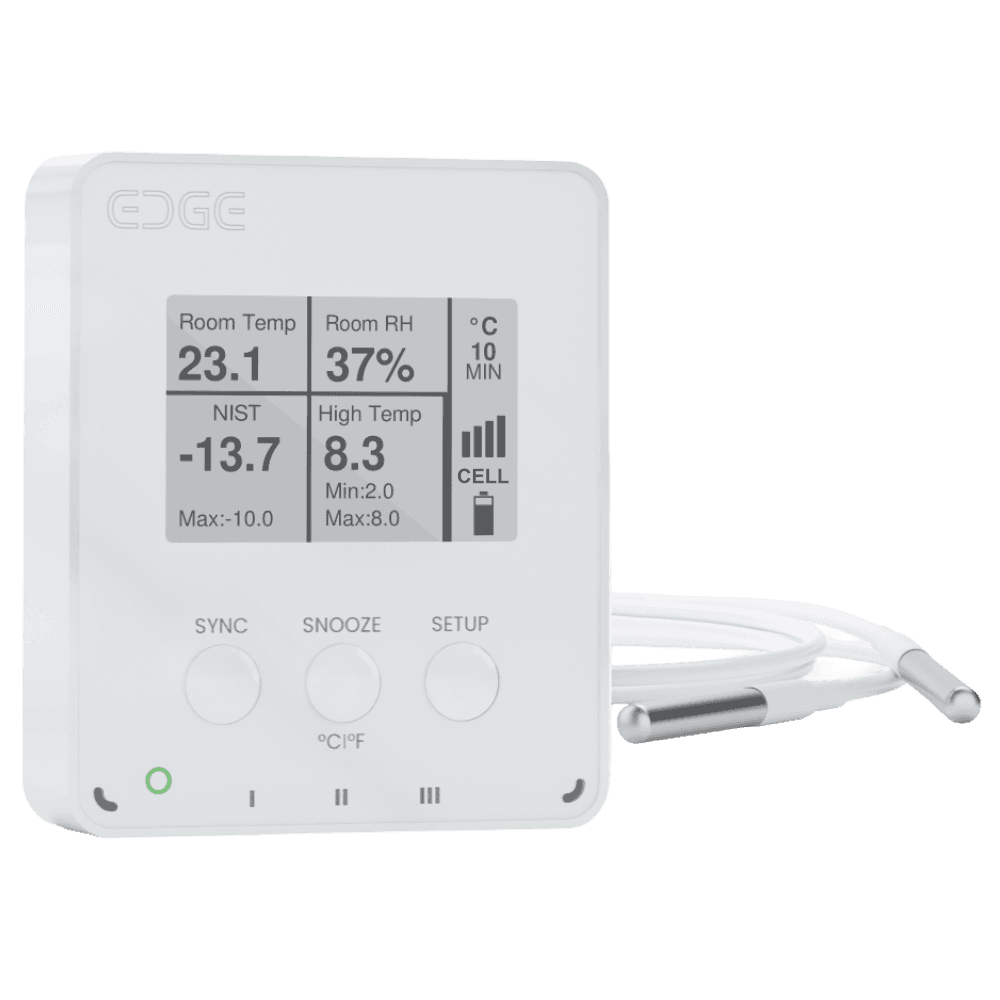
EDGE Thermo Cellular
Two external temperature probes on 1.5 m (4.9 ft) cables: tape one to the most exposed pipe and put the other in a freezer, a crawl space or a pump house.
$279
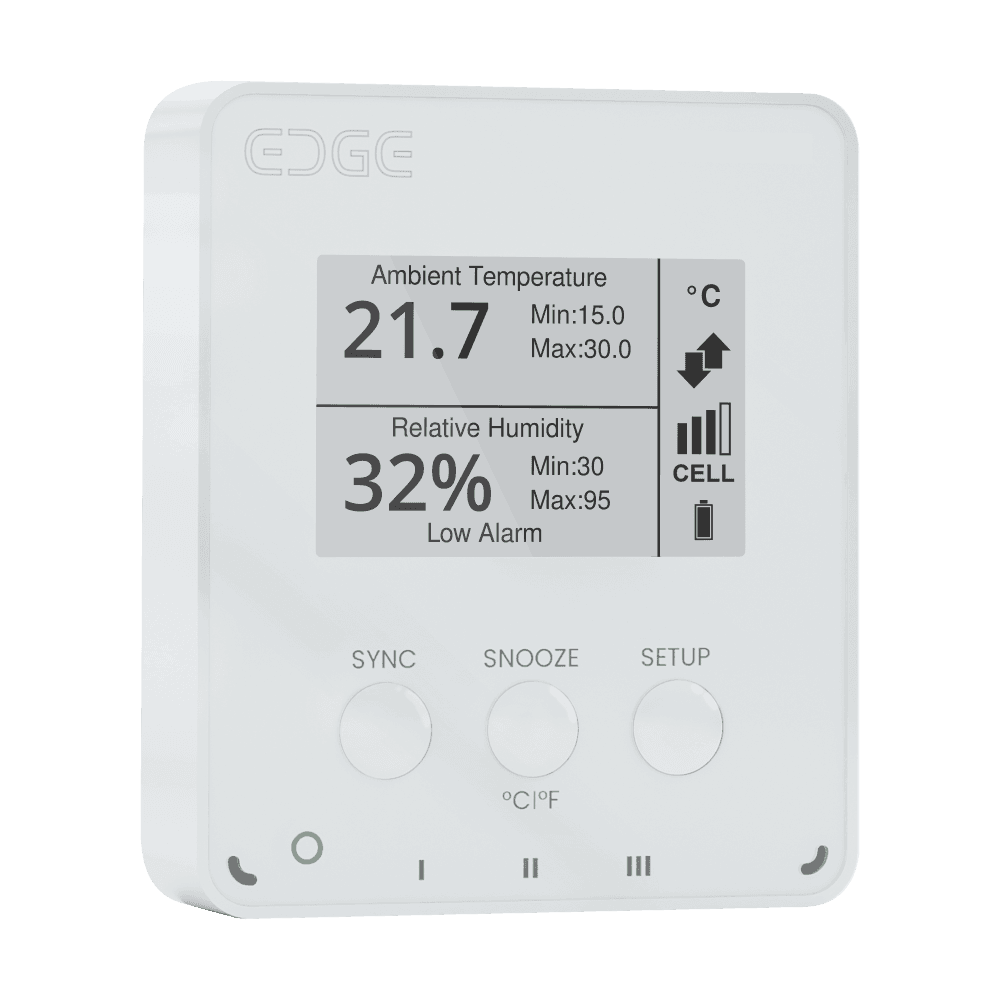
EDGE Essential Cellular
Room temperature and humidity in one box: the simplest freeze alarm for the main floor, with a humidity reading for damp and mold.
$239
Add leak detection
Spring thaw and a split pipe both end with water on the floor. Every EDGE except EDGE Essential PLUS has a dry-contact input for the Flood Detector Kit: 3 m (10 ft) of leak-sensing cable, with 3 m (10 ft) extensions up to 100 m (330 ft) per run. Lay it flat where water collects first, by the water heater, the pump or the floor drain. Or choose EDGE Essential Flood Cellular, which watches for leaks plus room temperature and humidity in one device.
What it costs over 3 and 5 years
Device plus service, before tax and shipping. EDGE prices are today’s shop prices, in Canadian dollars like CabinPulse’s; MarCELL and Temp Stick sell in US dollars. Competitor figures come from each maker’s own site, checked on October 14, 2026, at its cheapest published terms.
| Option | Connection and plan | 3 years | 5 years |
|---|---|---|---|
| EDGE Thermo Cellular | Cellular, no WiFi needed. Year 1 included, then $36 CAD/yr | $411 CAD | $483 CAD |
| EDGE Essential Cellular | Cellular, no WiFi needed. Year 1 included, then $36 CAD/yr | $361 CAD | $433 CAD |
| EDGE Essential WiFi | Needs WiFi. No plan needed after year 1 (free Standard tier) | $199 CAD | $199 CAD |
| CabinPulseFull comparison | Cellular, plugs into an outlet. Prepaid plan required | $559 CAD | $895 CAD |
| MarCELLFull comparison | Cellular, plugs into an outlet. US$95.96 on sale, plan required (US$99/yr on its annual plan) | about US$393 | about US$591 |
| Temp StickFull comparison | WiFi only. US$149, no subscription; shipping, duties and taxes extra for Canadian orders | US$149 | US$149 |
EDGE WiFi after the first year: the free Standard tier keeps live data, all alarms and the last 45 days of history, and Premium stays optional at about $17.78/year. A cellular device needs its plan after the first year to stay active.
EDGE figures in this table are in Canadian dollars. In the US store, EDGE prices are shown in US dollars on each product page.
Before you close the cottage
Fresh batteries, the low alarm set, the right people on the share and a check that the device is online: the winter freeze checklist takes about ten minutes.
Open the winter freeze checklistFrequently Asked Questions
What temperature should a cottage freeze alarm be set to?
A few degrees above freezing, so the alarm comes while there is still time to act: for example 5 °C (41 °F) on the room, or on a probe taped to the most exposed pipe. Water freezes at 0 °C (32 °F). If you leave the heat on, the American Red Cross advises a setting no lower than 13 °C (55 °F).
Do I need WiFi at the cottage for a freeze alarm?
Not with a cellular model. EDGE Cellular brings its own cellular data link, so it works with the cottage internet switched off for the winter, and it also works on WiFi if you have it. A WiFi alarm needs the router and the internet on all winter.
Is EDGE a power outage alarm?
A WiFi unit can only alert while your router has power and internet (put the router on a UPS). For outage alerts, choose a Cellular model on USB-C power: it reports a power cut at its next recording, by push, email and text.
Can the alarm call my phone?
Yes. When a reading crosses your limit, EDGE calls, texts, emails and pushes everyone the device is shared with, at the same time. Email and push are always free; texts and calls use prepaid alert credit, with about $3.70 included with every device. Power-cut notices go by push, email and text.
Does EDGE work in an unheated cottage?
Yes. EDGE was tested working at -30 °C (-22 °F) on both alkaline and lithium AA cells. Below 0 °C (32 °F) the screen stops updating and says so, but logging and alarms carry on.
Can I see the reading on the device itself?
Yes. Every EDGE has an e-ink screen that shows the current reading (on EDGE Thermo Cellular, both probes at once) and an on-screen alarm along with the buzzer, so whoever is at the cottage can check it at a glance without a phone. The screen updates at each recording interval. Below 0 °C (32 °F) it stops updating and says so, but logging and alarms carry on.
What does a cellular freeze alarm cost each year?
The first year of service is included with every EDGE Cellular. After that the plan is about $26.67/year (about $2.22/month), billed annually, with no contract. The cost table on this page compares 3 and 5 years with CabinPulse, MarCELL and Temp Stick.
Can it also catch a water leak?
Yes. Every EDGE except EDGE Essential PLUS has a dry-contact input for the Flood Detector Kit, 3 m (10 ft) of leak-sensing cable that extends up to 100 m (330 ft) per run, and EDGE Essential Flood Cellular watches for leaks plus room temperature and humidity in one device. A leak alarm reaches the same people, the same way, as a temperature alarm.
Is a freeze alarm enough for my home insurance?
Not on its own. The Insurance Bureau of Canada says most policies spell out how often a competent person must check the home to make sure the heat is on, and that if you are away more than four days during the heating season you must drain the plumbing or have the home checked. A freeze alarm tells you sooner when the heat fails; check your own policy for what it asks of you.
Sources
Facts and competitor prices on this page come from these pages, checked on :
- American Red Cross: frozen pipes (which pipes freeze most often; heat no lower than 55 °F (13 °C) when you are away)https://www.redcross.org/get-help/how-to-prepare-for-emergencies/types-of-emergencies/winter-storm/frozen-pipes.html
- Insurance Bureau of Canada: does my insurance cover damage caused by extreme cold? (heated part of the home, vacant homes, power cuts, pipe insulation)https://www.ibc.ca/news-insights/in-focus/does-my-insurance-cover-damage-caused-by-extreme-cold
- Insurance Bureau of Canada: types of home insurance coverage (away more than four days in the heating season)https://www.ibc.ca/insurance-basics/home/types-of-home-insurance-coverage
- CabinPulse pricing (device price, 1-year and 3-year prepaid terms)https://cabinpulse.com/plans
- MarCELL Multisensor product page (sale price, plan required)https://www.meetmarcell.com/product/temperature-humidity-monitor/
- MarCELL subscription plans (US$8.25 a month billed annually)https://www.meetmarcell.com/subscription-plans/
- Temp Stick products (US$149 on sale, US$159 regular)https://tempstick.com/products/
- Temp Stick home page (no fees, no subscriptions)https://tempstick.com/
- Temp Stick shipping policy (shipping charged and duties and taxes paid by Canadian customers)https://tempstick.com/shipping-policy/
Hear About the Cold Before the Pipes Do
EDGE Thermo Cellular: $279 with the first year of service included, then about $26.67/yr (about $2.22/mo), billed annually.
Shop EDGE Thermo Cellular