Prevent Mold Before It Starts with the 0–100% Mold Index
A continuous, scientific algorithm mapping temperature and relative humidity into a single, intuitive risk percentage—giving facility managers, landlords, and archivists early warning before spores colonize.
The 0–100% Mold Risk Scale Breakdown
Understand what each risk score tier signifies and the recommended actions to safeguard your environment.
Conditions are unfavorable for mold germination. Air is sufficiently dry or cool. Continuous monitoring active.
Spores may begin germination at a microscopic level under sustained moisture. Monitor ventilation and airflow.
Conditions allow small mold spots to become visible on susceptible surfaces. Action recommended: inspect dehumidification.
Fungal growth accelerates rapidly. Immediate action needed: drop relative humidity below 55% and increase fresh air exchange.
Widespread mold coverage across building materials or stored inventory. Professional remediation may be required.
Critical contamination risk. High probability of irreversible structural damage, organic rot, and indoor air health hazards.
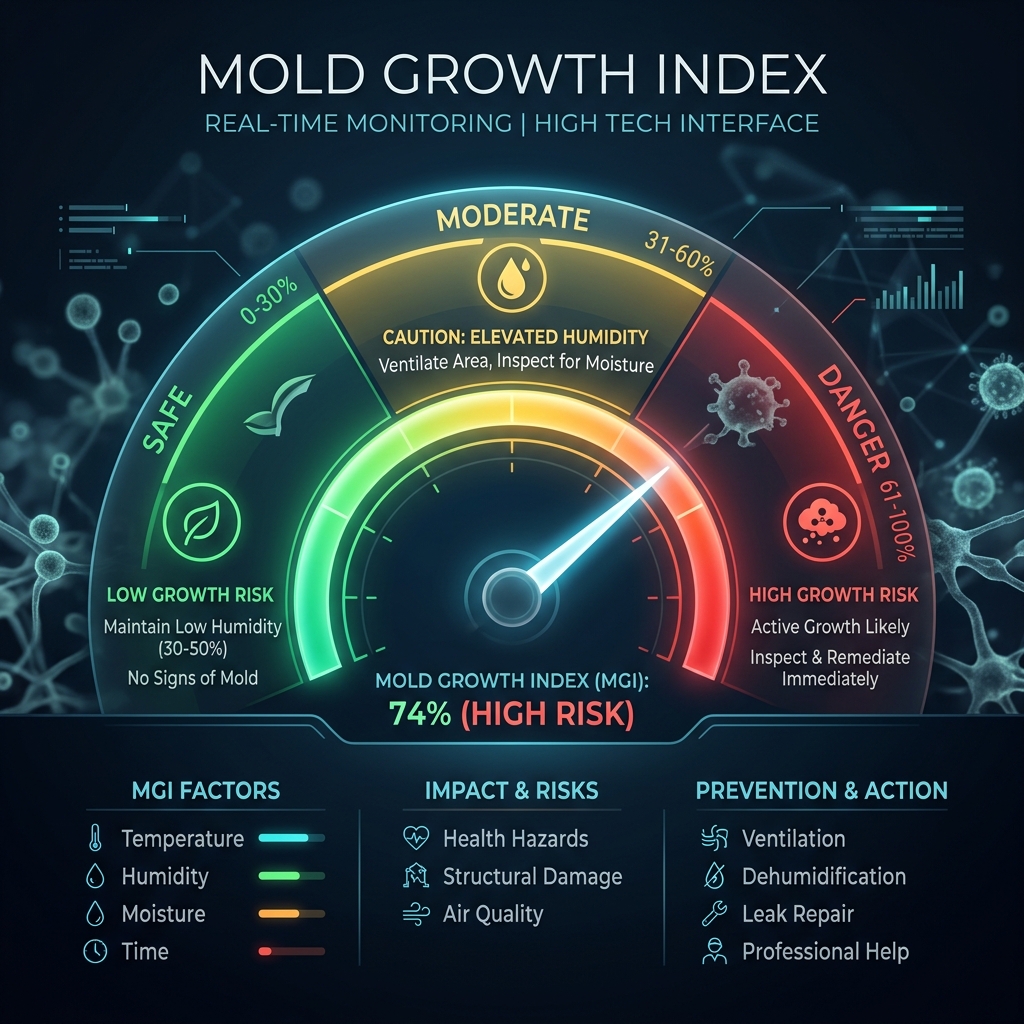
How the Mold Index Works
The MaxLinc Mold Index is shown as a 0% to 100% risk gauge. It is built from cumulative hours of elevated relative humidity alongside ambient temperature, so it tracks risk over time, not just single momentary spikes.
What the Mold Index Is (and Isn't)
It is NOT an Instant Air Spore Counter
The Mold Index does not optically count airborne spores or detect existing physical colonies on wall studs. Our sensors measure atmospheric drivers rather than physical spore counts.
It IS a Cumulative Predictive Indicator
Because mold spores require sustained moisture and warmth over hours or days to germinate, the Mold Index is a cumulative trend calculation that updates dynamically as environmental conditions evolve.
Compatible MaxLinc EDGE Devices
Every MaxLinc ambient sensor features built-in Mold Index calculations out of the box with zero external gateways.
EDGE Essential
Compact ambient temperature & humidity logger with optional dry-contact door or water flood sensor inputs.
EDGE Thermo
High-contrast E-paper display with two external probes (-55 to +125 °C / -67 to +257 °F) and built-in ambient mold risk calculation.
EDGE Air
Multi-parameter indoor air quality logger tracking Ambient Temp, RH, CO2 concentration, and Mold Index simultaneously.
EDGE Pharma
High-accuracy environmental logger with a NIST-traceable calibration certificate and an automatic audit trail.
Automated Multi-Channel Cloud Alarms
Never miss a developing humidity leak or crawlspace failure.
Custom Threshold Triggers
Set custom alert thresholds at 20%, 35%, or 50% Mold Index tailored to your specific building materials or sensitive inventory.
Cascading Multi-Channel Alerts
Receive automated Phone Calls, SMS text messages, Push Notifications, and Emails straight to your facility maintenance team.
No Gateway Required
Devices stream telemetry directly over 2.4 GHz WiFi or global eSIM cellular without expensive hubs, and with no monthly fee on WiFi.
Where Mold Index Protects Your Assets
Property & Vacant Rentals
Prevent costly water damage remediation (industry example: $20,000+) in vacant units, crawlspaces, attics, and plumbing chaseways.
Museums, Archives & Heritage
Protect rare manuscripts, oil paintings, and historical textiles from destructive foxing and fungal spores.
AgTech & Indoor Farming
Spot micro-climate humidity pockets that foster Botrytis (grey mold) or powdery mildew before crops are destroyed.
Commercial Warehousing
Maintain verified atmospheric bounds across high-density storage racks, cardboard packaging, and dry food inventory.
Further Reading
- ASHRAE Standard 160: Criteria for Moisture-Control Design Analysis in Buildings.
Stop Mold Before It Spreads
Deploy direct-to-cloud WiFi and cellular sensors with built-in Mold Index prediction today. No gateway required.